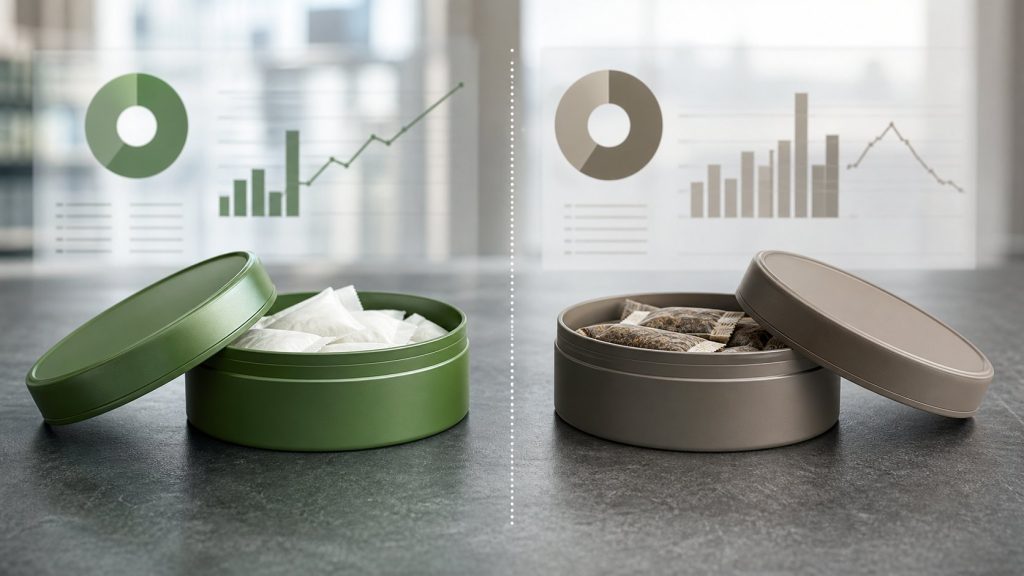


Quick answer: Slim mini pouches favor discretion, lower fill weight and compact packs, while standard pouches provide more formula capacity and may simplify higher-dose or botanical concepts. Wholesale cost depends on material use, machine compatibility, yield, count per tin and packaging—not size alone.
Format comparison
| Factor | Slim mini | Standard |
|---|---|---|
| Consumer feel | More discreet, smaller contact area | More noticeable, broader contact area |
| Formula capacity | Limited; favors concentrated actives | More room for extracts and carriers |
| Flavor release | Can be restrained or quicker depending on design | Can carry more moisture and flavor system |
| Pack architecture | Potentially compact tin or higher count | Fewer units or larger tin for same count |
| Channel fit | Office, travel and trial-oriented SKUs | Performance, botanical and value formats |
Fill capacity determines formula feasibility
Every milligram of active competes with flavor, sweetener, buffer, humectant and carrier. A slim format may work well for purified caffeine but become impractical for a bulky mushroom or amino-acid blend. Ask the manufacturer for usable fill range, flow requirements and uniformity data for the actual blend.
Comfort is not just about dimensions
Thickness, seam shape, fabric softness, moisture and swelling all affect comfort. A nominally small pouch can feel harsh if seams are rigid; a larger pouch can remain comfortable when thin and soft. Evaluate finished samples for placement stability, drip, rubbing and integrity.
Wholesale cost model
Compare pouch material, fill mass, units per tin, tins per case, production speed, scrap, tin size, labels, cartons and freight cube. A smaller pouch may use less blend but require more pieces per serving or tin, increasing machine time and counting complexity.
SKU strategy by channel
- Convenience: clear strength, familiar format and fast shelf communication.
- Office and travel: discreet mini profile and secure closure.
- Gym: recognizable serving and durable pack.
- Online subscription: count, repeat-use economics and mailbox-efficient shipping.
Questions for samples
Request exact dry and conditioned dimensions, target fill weight, tolerance, material, seam specification, moisture, count per tin and compatible packaging. Blind-test formats with the same flavor when possible so size is not confused with formula preference.
Frequently asked questions
Do slim pouches cost less?
Not necessarily. Lower material and fill can be offset by machine speed, higher unit count, scrap or custom packaging.
Which size holds more nootropic ingredients?
Standard formats generally provide more capacity, but usable dose depends on density, flow, taste and stability.
Can one machine make both sizes?
Sometimes, with tooling and setup changes. Confirm equipment capability, setup cost and MOQ per format.
Buyer due-diligence checklist
- Define the destination market, product classification and intended adult consumer.
- Approve a written finished-product specification rather than relying on a sales sample.
- Request lot traceability, relevant test methods, change control and complaint procedures.
- Compare landed cost, component minimums and reorder risk—not unit price alone.
Related resources: 2026 buyer’s guide, wholesale supplier checklist and OEM project inquiry.
Reviewed 13 August 2026. General educational procurement information only; obtain product-specific technical and regulatory advice.
Buyer decision summary
Use this page as a decision framework, not as a substitute for a signed product specification or market-specific review. A credible nootropic pouch project identifies the finished product category, the amount of every active per pouch, total caffeine from all sources, intended adult use, packaging configuration and target jurisdiction. Commercial figures such as MOQ and lead time should be tied to the actual formula, flavor, strength and artwork version. Before approval, compare a production-equivalent sample with measurable acceptance criteria and assign responsibility for claims, labels, release testing and later changes. This prevents a general marketing statement from being mistaken for a guaranteed specification and gives procurement, formulation, quality and regulatory teams the same reference point.
Key parameters to confirm
- Product identity: State whether the SKU contains nicotine, tobacco or caffeine; these are not interchangeable categories.
- Dose basis: Show every active amount per pouch and per serving, including caffeine from all sources.
- Evidence boundary: Describe intended support without promising treatment, disease prevention or guaranteed results.
- User boundary: Define adult-use guidance, warnings, maximum daily use and conditions requiring professional advice.
Continue this topic
- What Are Nootropic Pouches? A Practical Guide for First-Time Users
- How Do Nootropic Pouches Work? Release, Absorption and Onset Explained
- Are Nootropic Pouches Safe? A Caffeine, Ingredient and Oral-Comfort Checklist
Content status: Reviewed 13 September 2026. General B2B information; project-specific commercial, technical and regulatory details require written confirmation.