

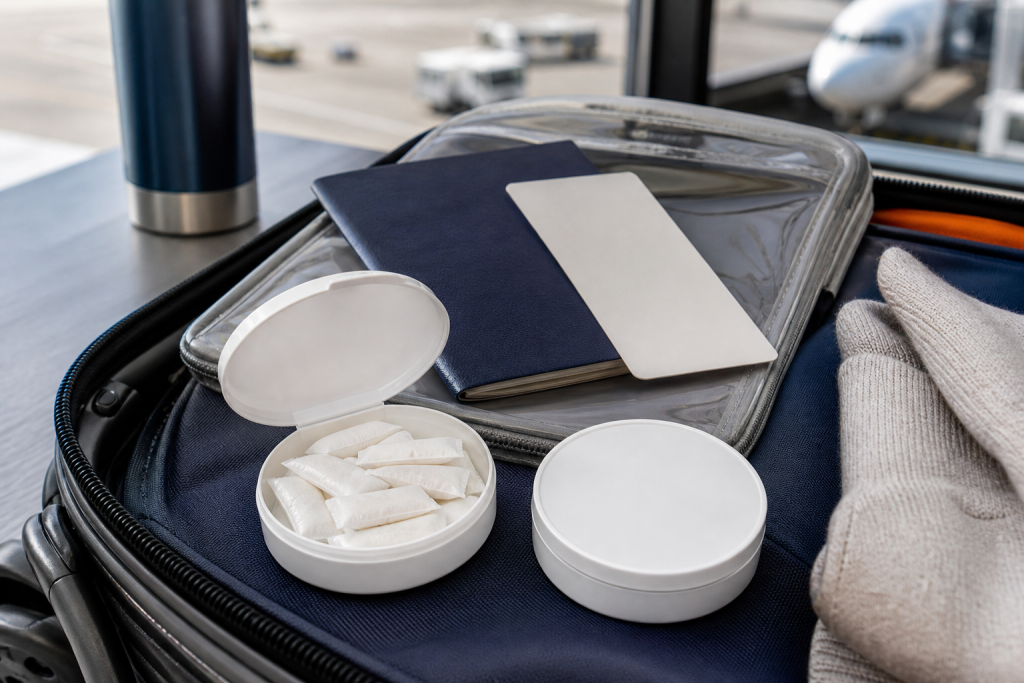
Quick answer: A solid, nicotine-free pouch product may be permitted in baggage under many airport-security rules, but security screening is not the same as legal import permission. Keep products in original labeled cans, carry a reasonable personal-use quantity and check the airline, departure airport, transit countries and destination customs rules before travel. Declare food or supplement products when required.
Security screening and customs are different
Airport security focuses on aviation safety and may inspect or open a container. Customs and health authorities decide whether a supplement or ingredient may enter a country. A product passing security screening at departure can still be restricted at arrival.
For U.S. screening, TSA states that solid food items may be carried in checked or carry-on baggage, while powder-like substances can receive additional screening. This is general guidance, not a product-specific approval. Review the current TSA What Can I Bring list before departure.
Keep the product identifiable
Use the original sealed or clearly labeled can. Do not move loose white pouches into an unmarked bag, mix formulas in one container or carry unlabeled powder. The label should identify the product, ingredients, caffeine amount, manufacturer or responsible business and use directions.
Pack cans so lids do not open under compression. A small secondary bag can contain accidental spills without hiding the product identity. Avoid heat exposure in parked vehicles or uncontrolled baggage areas when the label requires cool, dry storage.
Check ingredients and destination law
Nicotine-free does not mean universally unrestricted. Countries can classify caffeine, paraxanthine, botanicals, mushroom extracts, choline sources or oral-delivery formats differently. Transit rules may also matter even when the traveler does not leave the airport.
U.S. CBP advises travelers to declare food and agricultural items when entering the United States. Check the latest CBP declaration guidance and equivalent official destination sources. When uncertain, declare the product and present the original packaging.
Travel guidance for brands
A travel-oriented product page should not promise “TSA approved” or “legal worldwide.” Instead, provide the ingredient list, caffeine per pouch, net quantity, storage, batch and contact details so authorities and travelers can identify it. Export cartons and commercial samples require separate import documentation and are not equivalent to personal luggage.
Frequently asked questions
Can nootropic pouches go in carry-on luggage?
They may be accepted as a solid product under many screening systems, but the current airport, airline and destination rules must be checked. Screening officers retain authority over individual items.
Should I remove pouches from the original can to save space?
No. Original labeled packaging makes the product easier to identify and protects the pouches.
Are nicotine-free pouches legal in every country?
No universal conclusion is possible. Ingredient, supplement and oral-format rules vary by country and can change.
Related resources
See our usage guide, safety overview, packaging guide and OEM inquiry page.
Reviewed 30 August 2026. General educational information only; not medical, dental or legal advice.
Buyer decision summary
Use this page as a decision framework, not as a substitute for a signed product specification or market-specific review. A credible nootropic pouch project identifies the finished product category, the amount of every active per pouch, total caffeine from all sources, intended adult use, packaging configuration and target jurisdiction. Commercial figures such as MOQ and lead time should be tied to the actual formula, flavor, strength and artwork version. Before approval, compare a production-equivalent sample with measurable acceptance criteria and assign responsibility for claims, labels, release testing and later changes. This prevents a general marketing statement from being mistaken for a guaranteed specification and gives procurement, formulation, quality and regulatory teams the same reference point.
Key parameters to confirm
- Product identity: State whether the SKU contains nicotine, tobacco or caffeine; these are not interchangeable categories.
- Dose basis: Show every active amount per pouch and per serving, including caffeine from all sources.
- Evidence boundary: Describe intended support without promising treatment, disease prevention or guaranteed results.
- User boundary: Define adult-use guidance, warnings, maximum daily use and conditions requiring professional advice.
Continue this topic
- What Are Nootropic Pouches? A Practical Guide for First-Time Users
- How Do Nootropic Pouches Work? Release, Absorption and Onset Explained
- Are Nootropic Pouches Safe? A Caffeine, Ingredient and Oral-Comfort Checklist
Content status: Reviewed 13 September 2026. General B2B information; project-specific commercial, technical and regulatory details require written confirmation.