

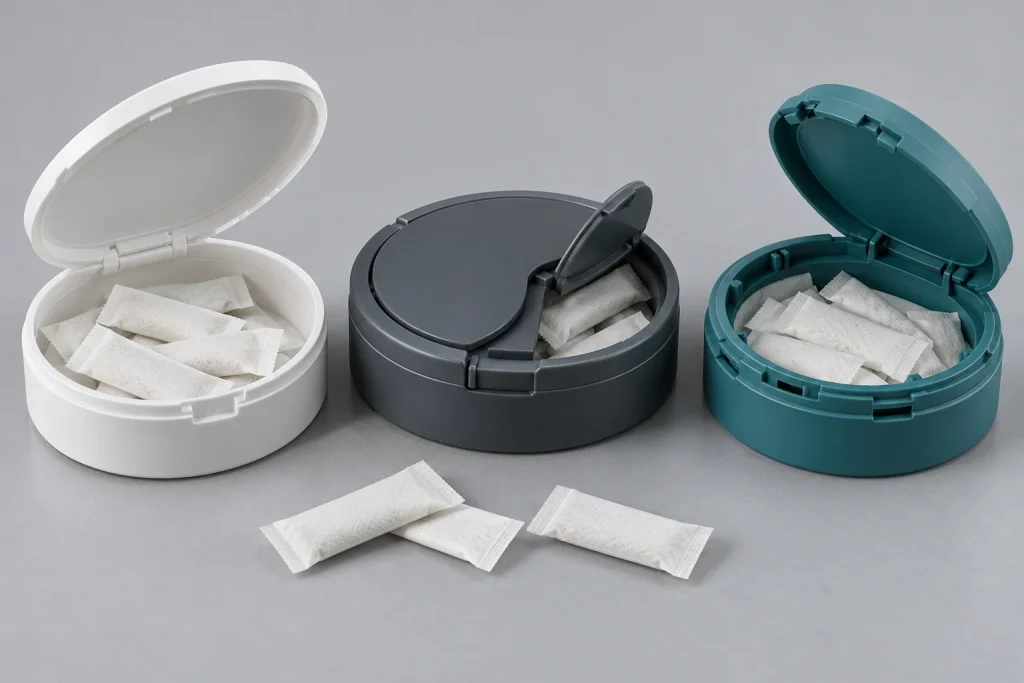
Answer first: Closure selection is a functional packaging decision, not a cosmetic one. Flip-top, single-opening and multi-opening cans change how users access pouches, how components are assembled, how the lid survives repeated use and how much label area remains available. A can described as child-resistant must not be marketed that way from appearance alone: resistance is a performance claim that requires testing of the exact package configuration under the applicable method and market rules.
What are the main oral pouch can closure families?
A standard removable lid offers a simple component set and broad decoration area. A hinged flip-top keeps the lid attached and can support one-handed access, but the hinge and latch become fatigue points. Dual- or three-opening designs divide access between compartments or lid features and require more assembly checks. Child-resistant catalog models use a more complex opening action; that construction is only a candidate until the complete pack is tested and documented.
| Closure family | Buyer use case | Primary verification |
|---|---|---|
| Removable or single opening | Simple pack architecture | Retention force, fit and repeated opening |
| Flip-top | Attached lid and quick access | Hinge fatigue, latch force and open/close cycling |
| Dual or three opening | Separated access or additional compartment | Component assembly, alignment and consumer comprehension |
| Child-resistant candidate | Projects requiring restricted access | Exact package performance testing and destination-market review |
Why can dimensions alone not determine capacity?
Outer diameter and height do not reveal usable internal volume, wall thickness, lid intrusion, liner space or how moist pouches settle. Capacity must be checked with the intended pouch dimensions, fill weight, moisture level and count. The correct approval uses production-representative pouches and measures closure engagement, headspace, pouch deformation and opening performance after storage. A 70 mm can from one mold should not be assumed interchangeable with another 70 mm design.
| Fit check | Acceptance question |
|---|---|
| Pouch count | Can the target number be packed without crushing or forcing the lid? |
| Headspace | Is there room for the closure, liner or seal without contact damage? |
| Moisture | Does storage change pouch thickness, adhesion or pack pressure? |
| Consumer access | Can a pouch be removed without tearing the substrate? |
| Label area | Does the decoration avoid hinges, latches and tamper features? |
What should be tested on a flip-top or multi-opening lid?
Test the molded parts as a system. Measure opening force and closure engagement on initial use and after repeated cycling; inspect stress whitening, cracks, hinge creep and latch wear. Condition samples at relevant temperatures because polymer stiffness changes with temperature. Run filled-pack drop and transport tests, then repeat opening checks. For multi-component lids, add assembly verification and line-clearance controls so the wrong insert or color is not fitted to a can.
| Test | What it can reveal |
|---|---|
| Dimensional inspection | Mold drift, warped rims and component mismatch |
| Opening/closing cycle | Hinge fatigue, latch wear and loss of retention |
| Drop and vibration | Unintended opening, cracking and pouch contamination risk |
| Temperature conditioning | Brittleness or excessive flexibility under distribution conditions |
| Filled-pack storage | Interaction between pouches, moisture, liner and closure |
When can a package be called child-resistant?
Only when the exact reclosable package has evidence against the applicable requirements. ISO 8317:2015 specifies performance requirements and test methods for reclosable packages and covers both restricting access by children and accessibility by adults; ISO also states that the standard is intended for type approval rather than routine quality assurance. In the United States, CPSC explains that the Poison Prevention Packaging Act applies to specified household substances and categories. A nootropic pouch brand must first determine whether a legal requirement applies to its product, then validate the precise can, contents and closure configuration.
| Evidence question | Buyer requirement |
|---|---|
| Which method? | Name the current standard, protocol and jurisdiction used |
| Which configuration? | Match resin, mold, lid, liner, contents and assembly to the marketed pack |
| Which report? | Obtain test laboratory, date, sample description and result |
| Which claims? | Use only language supported by the report and applicable law |
| Ongoing control | Monitor mold changes, supplier changes and closure complaints |
How should buyers compare the 22 available can models?
Start with the intended pouch and user workflow, then shortlist by closure family and dimensions. Request a drawing, material specification, component weights, carton data and current sample for each candidate. Use the site’s 22-model can catalog to compare the supplied dimensions and packaging data, but treat that catalog as a sourcing index rather than a certification record. The final purchase specification should identify the exact SKU and list every component included in the quotation.
What should be written into the packaging specification?
The specification should lock the can SKU, drawing revision, polymer and color reference, component set, critical dimensions, component weights, visual defects, opening-force method, assembly orientation, decoration area, carton quantity and change-notification requirement. Add reference samples and photographs where they improve defect decisions. If child resistance, food-contact suitability or barrier performance is required, identify the evidence and acceptance criteria separately rather than hiding them under a generic “compliant packaging” phrase.
Frequently asked questions
Is a flip-top can automatically child-resistant?
No. A hinge or complex appearance does not establish child resistance. The exact package requires applicable performance evidence.
Which can is best for 20 pouches?
There is no universal answer. Fit depends on pouch dimensions, fill weight, moisture, count, headspace and closure geometry, so a filled-pack trial is required.
What does ISO 8317 cover?
ISO 8317:2015 sets performance requirements and testing procedures for reclosable packages designated as child-resistant, including adult accessibility.
Should closure cycling be done before or after transport tests?
Both can be useful: establish baseline performance, expose filled packs to storage and distribution stresses, then repeat checks to detect degradation.
Authoritative references
- ISO 8317:2015 — Child-resistant packaging
- U.S. CPSC — Child Resistant Packaging
- Nootropic Pouch Cans — 22-model catalog
Related buyer resources
Reviewed October 22, 2026. Regulatory requirements and commercial terms should be confirmed for the exact product, supplier and destination market.