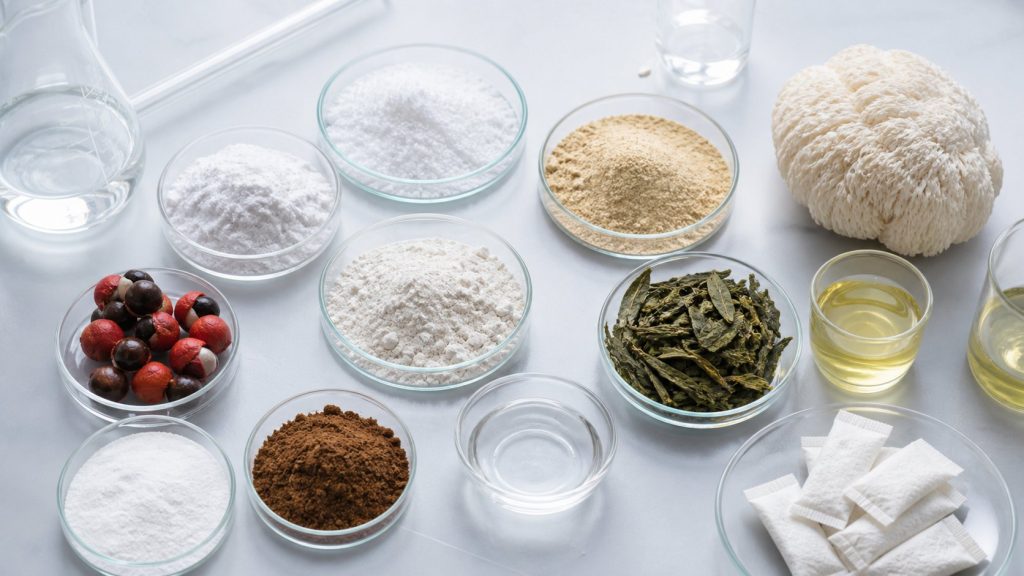


Quick answer: L-tyrosine is an amino acid used in stress-performance concepts, but its mass and taste can challenge compact oral pouch formulations.
Key takeaways
- Verify the exact current label, per-pouch amounts and nicotine-free identity.
- Distinguish ingredient evidence from finished-product evidence.
- Use responsible adult positioning and market-specific compliance review.
Definition and formulation context
Specify identity, assay, particle size and contaminants. Assess solubility, grittiness, bitterness and interaction with pH and flavor.
Evidence, release and limitations
Study conditions, doses and populations must be checked before translating research into marketing. A pouch inclusion amount may be much lower than amounts studied in swallowed formats.
Buyer and brand implications
Screen contraindications and interactions in the product safety review.
Formula and sourcing checklist
| Area | What to verify |
|---|---|
| Actives | Identity, amount per pouch, source, assay and lawful market status |
| Finished product | Uniformity, microbiology, moisture, pH, oral comfort and stability |
| Label | Category, caffeine disclosure, warnings, claims and responsible party |
| Commercial | MOQ per SKU, lead time, testing, packaging and landed cost |
Frequently asked questions
Does L-tyrosine provide instant focus?
Do not promise a universal immediate effect.
Can it be combined with caffeine?
It can be formulated together, but the full combination needs safety and sensory assessment.
Related buyer resources
Continue with our complete buyer’s guide, ingredient guide, safety overview and OEM inquiry page.
Authoritative background
Reviewed 13 August 2026. Educational information only; not medical or legal advice. Brand formulas may change—verify the current manufacturer label.
Buyer decision summary
Use this page as a decision framework, not as a substitute for a signed product specification or market-specific review. A credible nootropic pouch project identifies the finished product category, the amount of every active per pouch, total caffeine from all sources, intended adult use, packaging configuration and target jurisdiction. Commercial figures such as MOQ and lead time should be tied to the actual formula, flavor, strength and artwork version. Before approval, compare a production-equivalent sample with measurable acceptance criteria and assign responsibility for claims, labels, release testing and later changes. This prevents a general marketing statement from being mistaken for a guaranteed specification and gives procurement, formulation, quality and regulatory teams the same reference point.
Key parameters to confirm
- Per-pouch specification: Record ingredient identity, grade, active concentration, target amount and finished-product tolerance.
- Total stimulant load: Calculate caffeine from purified caffeine and botanical extracts.
- Sensory fit: Verify bitterness, sweetness, pH, moisture, pouch size and residence time on real samples.
- Evidence and claims: Match every proposed statement to substantiation and target-market rules.
Continue this topic
- Top Evidence-Based Nootropic Ingredients for Oral Focus Pouches (Dosing Breakdown)
- Caffeine vs Caffeine-Free Nootropic Pouch Formulas: Pros & Wholesale Demand
- L-Theanine Focus Pouches: Caffeine Pairing and Caffeine-Free Formulation
Content status: Reviewed 13 September 2026. General B2B information; project-specific commercial, technical and regulatory details require written confirmation.