
Quick answer: Ingredient selection should begin with evidence, lawful market status, dose feasibility and sensory performance—not the longest possible label. An oral pouch has limited fill capacity, so every milligram competes with carriers, flavors, sweeteners and moisture-control components.
Key takeaways
- Define the target market and lawful category before formula or artwork approval.
- Compare finished-product specifications, evidence and landed cost—not marketing claims alone.
- Use transparent quantities, risk-based testing and responsible adult positioning.
Caffeine and L-theanine
Caffeine has the clearest immediate alertness role. L-theanine is commonly paired with it for a balanced positioning. Buyers should define caffeine from every source, including guarana and tea extracts, and state the amount per serving.
L-tyrosine and choline sources
L-tyrosine and Alpha-GPC are popular in focus formulas, but commercial inclusion should follow ingredient specification, stability, taste and jurisdiction review. Do not assume capsule doses fit a small pouch.
Lion’s mane and botanicals
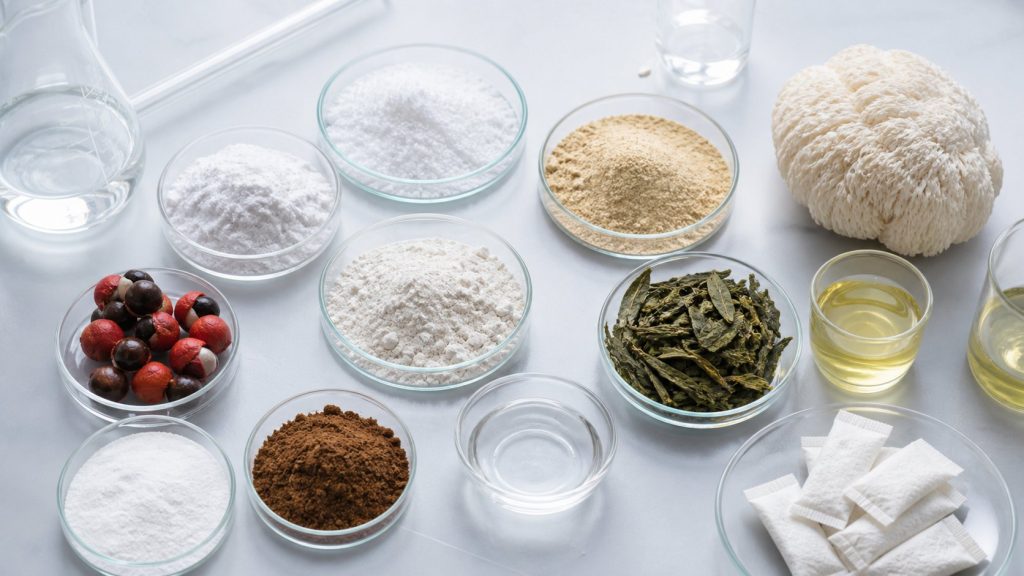
Mushroom and botanical extracts create differentiated caffeine-free products. Specify species, plant or fungal part, extraction ratio, marker compounds, carrier and contaminant limits.
Dose translation
Human studies often use formats and doses different from oral pouches. A brand should not copy a study headline without checking ingredient identity, population, dose and endpoint.
Buyer checklist
| Decision | Evidence to request |
|---|---|
| Formula | Per-pouch quantities, specifications, ingredient status and warnings |
| Factory | Current quality scope, batch records, traceability and corrective actions |
| Packaging | Dimensions, barrier, coding, MOQ, transport and shelf-life compatibility |
| Commercial | MOQ per SKU, sample policy, lead time, landed cost and reorder plan |
For an OEM feasibility review, see our white label nootropic pouches, facilities and contact pages.
Frequently asked questions
What is the best nootropic pouch ingredient?
There is no universal best ingredient. The choice depends on consumer need, evidence, dose space, flavor and legal status.
Should brands use proprietary blends?
Transparent per-pouch quantities make safety review and buyer comparison easier.
Authoritative sources and further reading
- U.S. FDA Dietary Supplement Labeling Guide
- EFSA: Caffeine
- UK guidance for food operators on supplements containing caffeine
- Health Canada: Supplemented Foods
Reviewed 9 August 2026. General educational information only; not medical or legal advice. Confirm classification, formula and labeling with qualified advisers in each target market.
Buyer decision summary
Use this page as a decision framework, not as a substitute for a signed product specification or market-specific review. A credible nootropic pouch project identifies the finished product category, the amount of every active per pouch, total caffeine from all sources, intended adult use, packaging configuration and target jurisdiction. Commercial figures such as MOQ and lead time should be tied to the actual formula, flavor, strength and artwork version. Before approval, compare a production-equivalent sample with measurable acceptance criteria and assign responsibility for claims, labels, release testing and later changes. This prevents a general marketing statement from being mistaken for a guaranteed specification and gives procurement, formulation, quality and regulatory teams the same reference point.
Key parameters to confirm
- Per-pouch specification: Record ingredient identity, grade, active concentration, target amount and finished-product tolerance.
- Total stimulant load: Calculate caffeine from purified caffeine and botanical extracts.
- Sensory fit: Verify bitterness, sweetness, pH, moisture, pouch size and residence time on real samples.
- Evidence and claims: Match every proposed statement to substantiation and target-market rules.
Continue this topic
- Caffeine vs Caffeine-Free Nootropic Pouch Formulas: Pros & Wholesale Demand
- L-Theanine Focus Pouches: Caffeine Pairing and Caffeine-Free Formulation
- Citicoline Nootropic Pouches: Cognizin®, Dose Space and Label Strategy
Content status: Reviewed 13 September 2026. General B2B information; project-specific commercial, technical and regulatory details require written confirmation.