
Quick answer: The caffeine molecule is the same regardless of whether it is isolated from guarana, tea or coffee or produced synthetically. For a nootropic pouch formulator, the practical differences are ingredient composition, caffeine standardization, taste, color, carrier load, documentation, cost, supply consistency and labeling—not a different caffeine molecule. The right option depends on the product brief and target market.
What “natural caffeine” means in a pouch formula
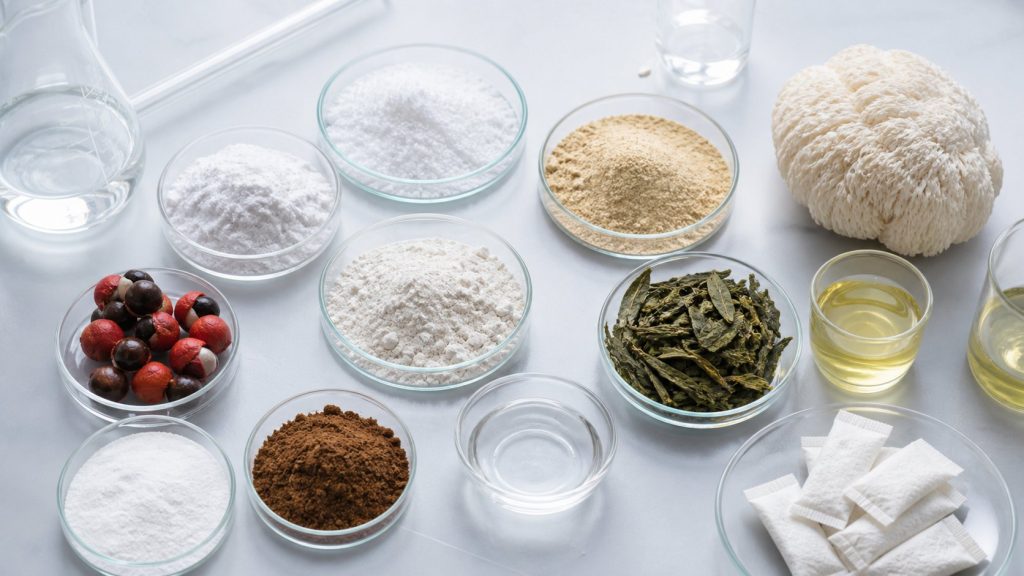
Natural-source caffeine may enter a formula as a botanical extract standardized to a stated caffeine percentage or as purified caffeine derived from a plant source. Those are not equivalent commercial materials. A guarana extract can contain botanical solids, carriers and other constituents, while highly purified plant-derived caffeine may behave much more like synthetic caffeine in manufacturing.
A buyer should request the botanical species, plant part, extraction details, carrier, caffeine assay range, contaminants specification and calculation showing total caffeine per pouch. “Guarana 100 mg” does not mean “caffeine 100 mg.”
Formulation comparison
| Decision factor | Natural-source extract | Synthetic / highly purified caffeine |
|---|---|---|
| Caffeine standardization | Depends on extract specification and lot assay | Usually high purity and easier dose calculation |
| Taste and color | May bring bitterness, tannins, color or botanical character | Primarily strong caffeine bitterness with little botanical color |
| Fill-space demand | More material may be needed to deliver the target caffeine amount | Less material is generally needed at high purity |
| Marketing story | Supports a botanical-source narrative when accurately described | Supports a simple, consistent and cost-controlled formula |
| Supply and cost | Influenced by crop, extraction, carrier and standardization | Often more predictable, subject to supplier and purity controls |
| Testing | Identity plus caffeine assay and botanical risk controls | Identity, purity and caffeine assay controls |
The molecule is the same, but the ingredient is not
Caffeine from different sources has the same chemical identity. That does not make every ingredient interchangeable. An extract may contain other xanthines or polyphenols and may change flavor, flow, solubility and stability. Claims that natural caffeine is inherently “cleaner,” “safer” or “longer lasting” require evidence and should not be assumed from source alone.
Guarana extract calculation example
If an extract is specified at 22% caffeine, delivering 40 mg of caffeine theoretically requires about 182 mg of that extract before accounting for assay tolerances and manufacturing controls. That extra mass competes with L-theanine, amino acids, flavors, sweeteners, humectants and pouch substrate capacity. The manufacturer should calculate from the approved specification and verify finished-product uniformity rather than relying only on the nominal input.
Taste masking and oral comfort
Caffeine is intensely bitter. Botanical extracts can add astringency, earthiness and color. Mint, citrus, berry and coffee profiles can help, but simply increasing flavor intensity may create gum irritation or an artificial aftertaste. Development samples should be evaluated for bitterness onset, aroma, cooling, drip, pouch softness and residual taste across the intended use period.
Labeling and total caffeine disclosure
Count caffeine from every source, including guarana, tea and coffee extracts. The label and warnings must follow the product classification and target-market rules. A botanical ingredient name should not obscure the actual stimulant amount. Avoid presenting “natural” as proof of safety, and do not imply that a pouch is suitable for children, pregnancy or caffeine-sensitive consumers.
Supplier documents to request
- Identity and purity specification or botanical identity, plant part and extraction information
- Lot-specific certificate of analysis with caffeine result
- Carrier and processing-aid disclosure
- Heavy metals, pesticides, residual solvents and microbiological controls based on risk
- Allergen and GMO statements where relevant
- Storage, retest or expiry information
- Change-notification agreement for source or process modifications
Which caffeine source fits which product?
A botanical-led premium SKU may justify standardized guarana or tea extract if the taste, dose space, documentation and cost work. A compact high-precision formula may favor purified caffeine for consistency and lower material load. Some brands use a blend, but the combination should solve a defined formulation or positioning need rather than make the ingredient list look longer.
For adjacent decisions, read our caffeine versus caffeine-free formula guide, ingredient dosing overview and pouch formulation guide.
Frequently asked questions
Is natural caffeine chemically different from synthetic caffeine?
No. Caffeine has the same molecular identity. The surrounding ingredient matrix, purity, carrier and other extract constituents can differ.
Is guarana caffeine-free?
No. Guarana naturally contains caffeine. Its caffeine contribution must be calculated and included in total intake information.
Does natural caffeine last longer?
That should not be claimed as a universal property. Any meaningful difference in a finished pouch needs evidence for the exact ingredient and formulation.
Which source is cheaper for OEM production?
Purified synthetic caffeine is often cost-efficient per milligram, while botanical extracts may support premium positioning. Compare standardized delivered caffeine, testing, flavor work, wastage and supply risk—not price per kilogram alone.
Authoritative sources
- Food Standards Australia New Zealand: Caffeine purity and sources
- EFSA: Caffeine
- U.S. FDA: How Much Caffeine Is Too Much?
Reviewed 12 August 2026. General formulation information only; conduct product-specific safety and regulatory review.
Buyer decision summary
Use this page as a decision framework, not as a substitute for a signed product specification or market-specific review. A credible nootropic pouch project identifies the finished product category, the amount of every active per pouch, total caffeine from all sources, intended adult use, packaging configuration and target jurisdiction. Commercial figures such as MOQ and lead time should be tied to the actual formula, flavor, strength and artwork version. Before approval, compare a production-equivalent sample with measurable acceptance criteria and assign responsibility for claims, labels, release testing and later changes. This prevents a general marketing statement from being mistaken for a guaranteed specification and gives procurement, formulation, quality and regulatory teams the same reference point.
Key parameters to confirm
- Per-pouch specification: Record ingredient identity, grade, active concentration, target amount and finished-product tolerance.
- Total stimulant load: Calculate caffeine from purified caffeine and botanical extracts.
- Sensory fit: Verify bitterness, sweetness, pH, moisture, pouch size and residence time on real samples.
- Evidence and claims: Match every proposed statement to substantiation and target-market rules.
Continue this topic
- Top Evidence-Based Nootropic Ingredients for Oral Focus Pouches (Dosing Breakdown)
- Caffeine vs Caffeine-Free Nootropic Pouch Formulas: Pros & Wholesale Demand
- L-Theanine Focus Pouches: Caffeine Pairing and Caffeine-Free Formulation
Content status: Reviewed 13 September 2026. General B2B information; project-specific commercial, technical and regulatory details require written confirmation.