

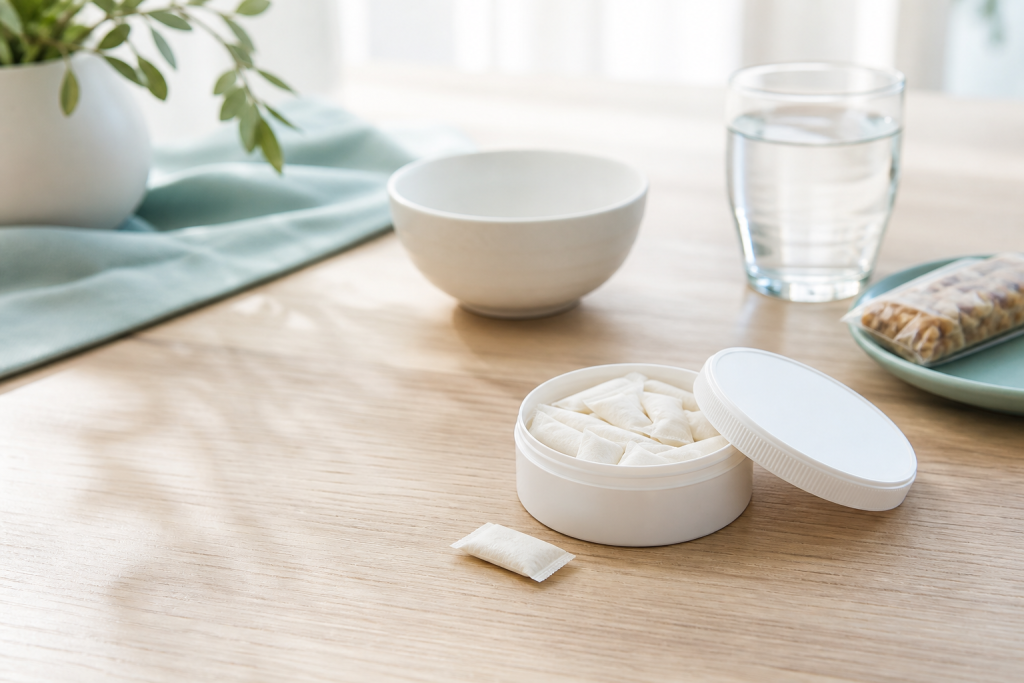
Quick answer: Some adults may tolerate a nootropic pouch before eating, while others may experience nausea, stomach discomfort, dizziness or a more noticeable caffeine response. There is no universal empty-stomach rule because formulas, doses and individuals differ. Follow the exact label, start with the lowest labeled serving and remove the pouch if unwanted effects occur.
Why the answer depends on the formula
A caffeine-free pouch and a 50 mg caffeine pouch are not equivalent. Caffeine may also come from guarana, tea, coffee extract or other ingredients, and every source should be included in the per-pouch total. L-theanine, tyrosine, choline sources, botanicals, acids, sweeteners and cooling agents have their own tolerability considerations.
Placement under the lip does not mean the stomach is irrelevant. Some dissolved material is normally swallowed with saliva. The proportion absorbed through oral tissue versus the digestive tract varies by ingredient and finished formula, so brands should avoid universal faster-absorption claims.
Possible signs that the timing does not suit you
Nausea, stomach upset, shakiness, headache, racing heartbeat, dizziness or strong mouth irritation are reasons to remove the pouch and stop use. Eating does not guarantee prevention of side effects, and food should not be presented as a way to make an excessive dose safe.
People who are pregnant or breastfeeding, minors, caffeine-sensitive users, people with medical conditions and those taking medications should follow label warnings and seek professional guidance where appropriate.
How to compare products responsibly
Read milligrams per pouch, the labeled serving, maximum daily amount and caffeine from every source. Do not stack a pouch with coffee, pre-workout or energy drinks without calculating the combined amount. Natural caffeine still counts.
If a label requires use with food, follow it. If it gives no meal instruction, that does not prove every user will tolerate fasting use. Product-specific directions and individual response are more useful than generalized social-media advice.
What OEM brands should test
Finished-product sensory testing should record salivation, bitterness, cooling, nausea reports and oral comfort at defined times. The label should state placement, duration, per-pouch quantities, serving limits, stimulant warnings and stop-use guidance. Do not advertise that empty-stomach use guarantees a faster or stronger cognitive effect.
Frequently asked questions
Does an empty stomach make a nootropic pouch work faster?
A universal claim is not supported. Ingredient, dose, release, swallowed fraction, food and individual physiology all matter.
Can food reduce caffeine side effects?
Food may change the experience for some people, but it does not remove caffeine exposure or guarantee tolerability.
Are caffeine-free pouches automatically suitable before breakfast?
No. Caffeine-free formulas can still contain ingredients that cause intolerance or interact with individual conditions.
Related resources
See our usage guide, safety overview, packaging guide and OEM inquiry page.
Reviewed 30 August 2026. General educational information only; not medical, dental or legal advice.
Buyer decision summary
Use this page as a decision framework, not as a substitute for a signed product specification or market-specific review. A credible nootropic pouch project identifies the finished product category, the amount of every active per pouch, total caffeine from all sources, intended adult use, packaging configuration and target jurisdiction. Commercial figures such as MOQ and lead time should be tied to the actual formula, flavor, strength and artwork version. Before approval, compare a production-equivalent sample with measurable acceptance criteria and assign responsibility for claims, labels, release testing and later changes. This prevents a general marketing statement from being mistaken for a guaranteed specification and gives procurement, formulation, quality and regulatory teams the same reference point.
Key parameters to confirm
- Product identity: State whether the SKU contains nicotine, tobacco or caffeine; these are not interchangeable categories.
- Dose basis: Show every active amount per pouch and per serving, including caffeine from all sources.
- Evidence boundary: Describe intended support without promising treatment, disease prevention or guaranteed results.
- User boundary: Define adult-use guidance, warnings, maximum daily use and conditions requiring professional advice.
Continue this topic
- What Are Nootropic Pouches? A Practical Guide for First-Time Users
- How Do Nootropic Pouches Work? Release, Absorption and Onset Explained
- Are Nootropic Pouches Safe? A Caffeine, Ingredient and Oral-Comfort Checklist
Content status: Reviewed 13 September 2026. General B2B information; project-specific commercial, technical and regulatory details require written confirmation.