

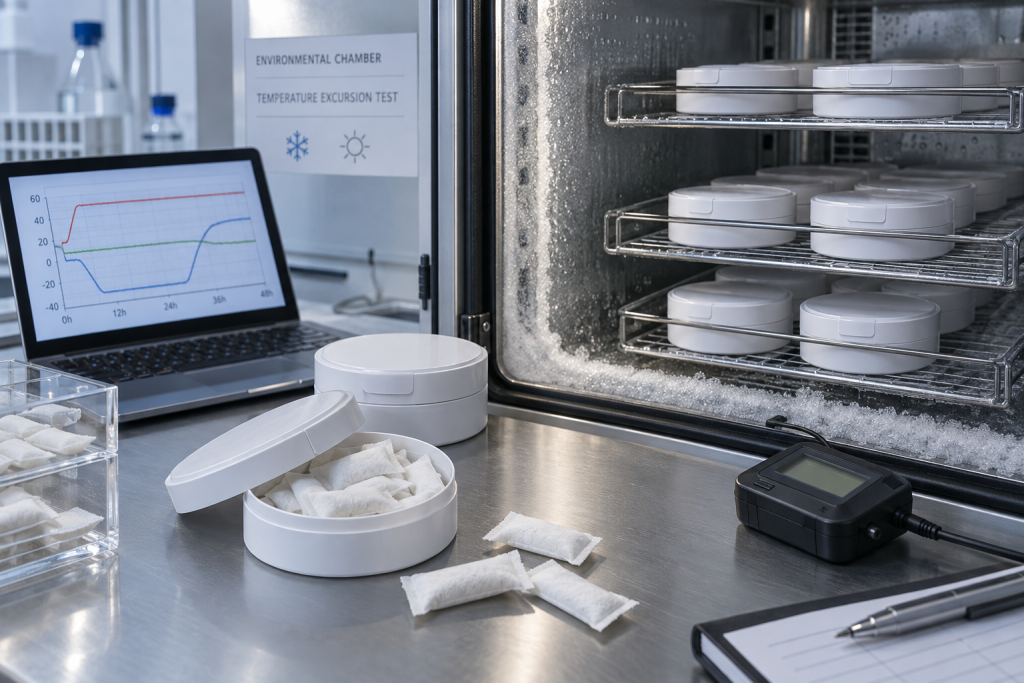
Map realistic distribution exposures
Use lane data, carrier information, warehouse conditions and data loggers to identify plausible duration and temperature ranges. Separate a short parcel excursion from long warehouse abuse. Consider solar heating, unconditioned containers, air cargo, winter last-mile delivery and repeated consumer opening after receipt. The study should represent a defined event and packaging configuration. An extreme chamber cycle that no shipment will encounter may be useful for stress screening but should not be presented as proof of routine shelf life.
Choose attributes from the formulation risk
Heat can accelerate flavor loss, oxidation, discoloration or active degradation; cold may change crystallization, texture or adhesion; humidity and condensation can alter powder flow and pouch feel. Select tests from ingredient and packaging knowledge. Typical observations include appearance, odor, taste, pouch dimensions, seam integrity, clumping, can opening, label condition, moisture or water activity and assay for critical actives. Microbiological testing may be appropriate when moisture control is affected.
Use controls and predefined acceptance criteria
Condition test units and retain matched controls from the same batch in recommended storage. Define chamber tolerances, monitoring, sample count, evaluation time points and pass criteria before the study. After cold exposure, allow controlled equilibration before opening to avoid creating condensation that would not occur in the intended handling sequence. Record every deviation. A passing result applies to the tested formula, pack, orientation and profile, not automatically to all flavors or future component changes.
Turn results into shipment decisions
The quality agreement should state who reviews logger alarms, what information the logistics provider supplies, how affected lots are quarantined and when additional testing or rejection is required. Build a decision tree using maximum and cumulative exposure, stability knowledge and package condition. Requalify after changes to active ingredients, flavor system, moisture target, pouch material, can resin, closure, liner, case pack or shipping route. Keep reports with batch and lane records so future excursions can be assessed consistently.
Key parameters buyers should record
- Target market, sales channel and responsible business
- Formula, amount per pouch, pouch count and commercial packaging configuration
- Test method, conditions, sample status and predefined acceptance criteria
- Named owner for approval, deviations, changes and release
Frequently asked questions
Must every nootropic pouch formula be freeze-thaw tested?
No. Use ingredient, packaging and route risks to decide whether freezing or repeated cycles are plausible and meaningful.
Can appearance alone release an exposed shipment?
Usually not when critical attributes may change invisibly. Use the documented risk assessment and relevant analytical or physical tests.
Does accelerated testing replace real-time stability?
No. It can support development and risk assessment, while real-time data remains important for the commercial shelf-life rationale.
Source and related reading
Technical boundary references include the FDA dietary supplement CGMP guide. Continue with the quality-control buyer guide, packaging guide and OEM project inquiry.
Reviewed 29 September 2026. General B2B educational information; confirm product, market, laboratory, customs and contractual requirements for the actual project.