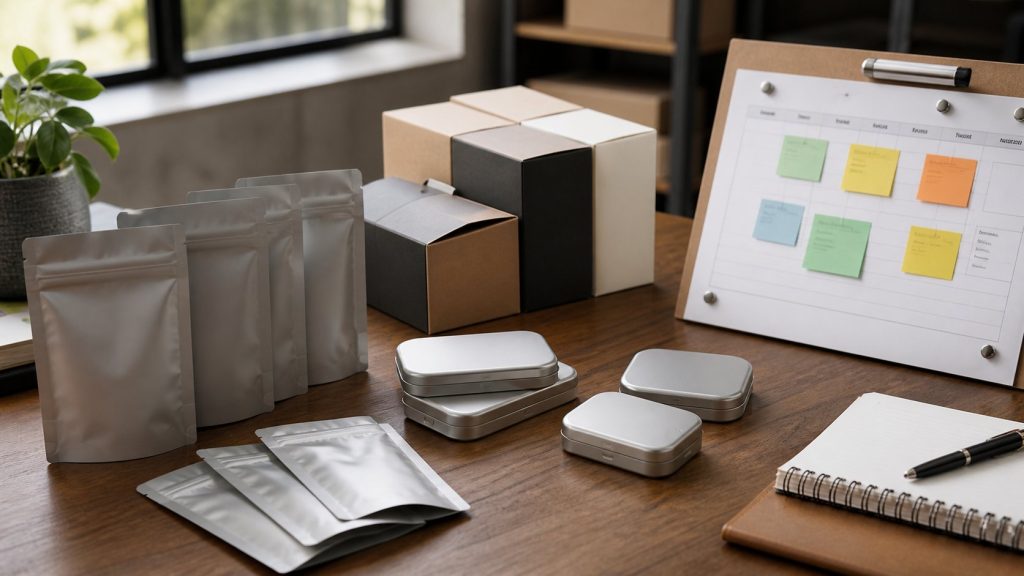


Quick answer: White label nootropic pouches use a manufacturer’s existing formula and format with your branding, while private label or custom OEM projects change the formula, flavor, strength, pouch or packaging for a more differentiated product. White label is usually faster and requires fewer development decisions; custom private label offers more control but adds validation, component minimums, cost and schedule risk.
White label and private label are not universal legal terms
Suppliers use these labels differently. One factory may call a stock formula with custom artwork “private label,” while another reserves that term for a unique formula. Define the project by what actually changes: ingredient list, dose, flavor, pouch dimensions, substrate, pack count, tin, label, testing and ownership. Put those details in the quotation and quality agreement.
Side-by-side buyer comparison
| Commercial factor | White label route | Custom private label / OEM route |
|---|---|---|
| Formula | Existing approved manufacturer formula | Brand-specific or materially modified formula |
| Development time | Focused on samples, artwork and pack approval | Includes feasibility, trials, revisions and validation |
| MOQ drivers | Finished goods and standard packaging | Ingredients, each flavor, print components and production setup |
| Differentiation | Brand, pack design and assortment | Formula, strength, sensory profile, format and packaging |
| Testing burden | Existing evidence may be bridged if unchanged | New formula and packaging need a defined test and stability plan |
| Launch risk | Lower technical complexity | Higher control but more technical and schedule variables |
What determines MOQ?
There is no meaningful “standard MOQ” without a SKU definition. Ask whether the minimum applies per formula, caffeine strength, flavor, tin color, artwork version and language. Printed tins, cartons and specialty pouch materials can have component minimums greater than the filling run. Also ask who owns and stores unused packaging and whether it can be used for reorders.
How to compare launch cost
Separate the quotation into development, samples, raw materials, production, packaging, print tooling, laboratory testing, stability, freight, duty and warehousing. White label can have a higher finished-unit price but a lower total launch commitment. A custom project may achieve better economics at scale while requiring more cash before the first sale.
A realistic timeline framework
- Commercial brief: target market, consumer, ingredients, serving, flavor, packaging, forecast and claims.
- Feasibility and quotation: supplier reviews dose space, ingredient status, component availability and test needs.
- Samples: stock sample approval for white label or iterative prototypes for custom work.
- Specification and artwork: approve formula, tolerances, sensory standard, label copy and print proof.
- Procurement and production: components are ordered, materials released and the batch manufactured.
- Release and shipment: finished-product checks, document approval and export preparation.
Any fixed online promise should be treated as an estimate until the supplier confirms your exact formula, component availability, testing and production slot.
When white label is the stronger choice
- You need to validate demand before funding a custom formula.
- Your differentiation is mainly brand, channel, education or packaging.
- You want fewer SKUs and faster reorder planning.
- The existing formula already fits the target-market and consumer brief.
When custom private label is worth the complexity
- A specific ingredient, caffeine tier or caffeine-free profile is central to the proposition.
- You need a distinct flavor, pouch size, release profile or packaging system.
- Forecast volume can absorb development and component minimums.
- Your team can manage regulatory review, specifications, testing and change control.
Contract points buyers often miss
Document formula ownership and confidentiality, approved suppliers, substitution rules, specifications, test methods, release authority, deviations, change notification, complaints, recalls, rejected lots, unused packaging, reorder lead times and exit rights. A colorful sample is not a substitute for a controlled commercial specification.
Hybrid route: semi-custom launch
A semi-custom program can keep a validated base while changing flavor, caffeine tier or packaging. This may provide useful differentiation without rebuilding every element. It still requires a documented assessment of whether the change affects safety, label, sensory performance, testing or shelf life.
Use our sample RFQ template, low-MOQ OEM guide and wholesale supplier checklist to compare factories consistently.
Frequently asked questions
Which route has the lowest MOQ?
White label often has the lower technical entry point, but packaging and per-SKU minimums still apply. Compare total cash commitment, not only the advertised minimum.
Can a white label product use custom packaging?
Usually yes, subject to the manufacturer’s pack options and the printer’s MOQ. Custom packaging may become the longest-lead component.
Who owns a private label formula?
Ownership depends on the contract. Do not assume that paying a development fee transfers formula ownership or exclusivity.
Can one formula be sold in every country?
No. Ingredient status, classification, label language, warnings and claims vary. Review each destination before formula and artwork approval.
Authoritative sources
- U.S. FDA Dietary Supplement Labeling Guide
- U.S. FDA: Dietary Supplement cGMPs
- EFSA: Food Supplements
Reviewed 12 August 2026. General procurement information only; confirm commercial and legal terms for the exact project.
Buyer decision summary
Use this page as a decision framework, not as a substitute for a signed product specification or market-specific review. A credible nootropic pouch project identifies the finished product category, the amount of every active per pouch, total caffeine from all sources, intended adult use, packaging configuration and target jurisdiction. Commercial figures such as MOQ and lead time should be tied to the actual formula, flavor, strength and artwork version. Before approval, compare a production-equivalent sample with measurable acceptance criteria and assign responsibility for claims, labels, release testing and later changes. This prevents a general marketing statement from being mistaken for a guaranteed specification and gives procurement, formulation, quality and regulatory teams the same reference point.
Key parameters to confirm
- Target jurisdiction: Classify the finished product before finalizing formula, claims, directions or artwork.
- Label owner: Assign approval of mandatory copy, warnings, responsible-business details and translations.
- Claims boundary: Avoid disease, ADHD, IQ, cure or guaranteed-performance language unless specifically permitted and substantiated.
- Change control: Re-review after ingredient, dose, supplier, serving, market or packaging changes.
Continue this topic
- Nootropic Pouch Regulations and Labeling: Questions to Ask Before Launch
- Nootropic Pouch FDA Label Claims: Focus Support Without Medical Language
Content status: Reviewed 13 September 2026. General B2B information; project-specific commercial, technical and regulatory details require written confirmation.