
Quick answer: A credible lion’s mane pouch brief specifies Hericium erinaceus, the fungal material used, extraction method, carrier, marker or composition testing, contaminants limits and the actual amount per pouch. Buyers should not treat all “10:1” extracts as equivalent or make memory and disease claims that the finished product cannot substantiate.
Raw powder, fruiting body and mycelium
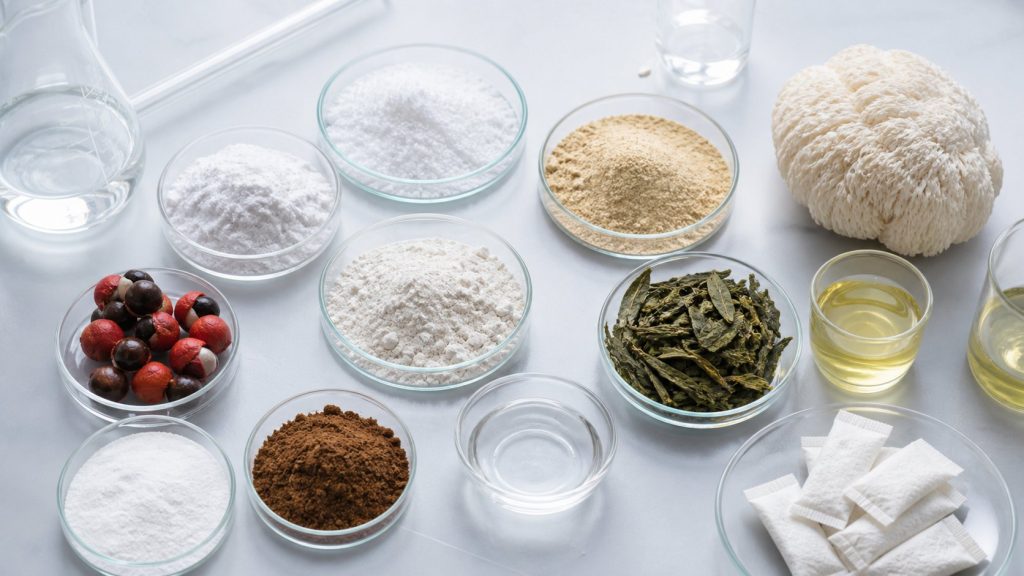
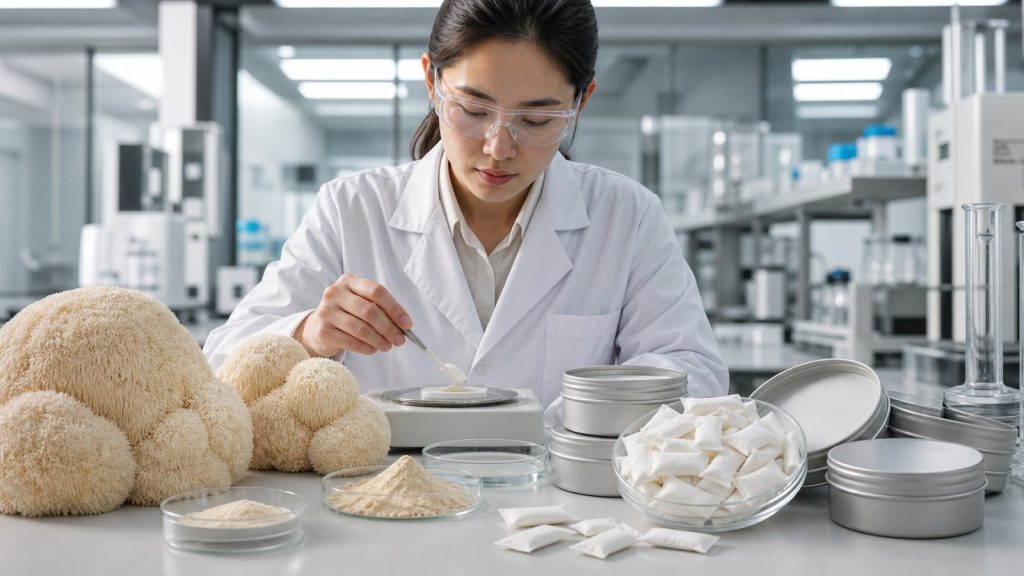
Lion’s mane materials may be whole powder, fruiting-body extract, mycelium-derived material or a blend. Each can differ in composition, taste, color, carrier load and documentation. The commercial specification should identify the material precisely and avoid implying that an extraction ratio alone proves quality.
Supplier specification checklist
- Latin name and fungal part or culture material
- Extraction solvent, ratio and concentration method
- Carrier identity and percentage
- Identity method and relevant composition markers
- Microbiology, heavy metals, pesticides and residual-solvent controls
- Allergen, GMO, storage and change-notification statements
Dose-space reality in an oral pouch
A pouch has limited fill capacity. Mushroom extracts can require substantially more mass than purified caffeine, leaving less room for flavor, sweetener, humectant and supporting actives. Do not copy capsule serving sizes into a pouch without feasibility, uniformity, sensory and safety review. State the exact ingredient amount instead of hiding it inside an opaque blend.
Taste, texture and color
Lion’s mane can add earthy, savory or bitter notes and visible color. Mint, coffee, cocoa, vanilla or restrained fruit systems may be explored, but strong masking can irritate the mouth. Evaluate aroma, bitterness, drip, softness and aftertaste over the intended placement period and during stability.
Caffeine-free versus blended concepts
A caffeine-free mushroom pouch offers a clear non-stimulant assortment position, but “caffeine-free” does not prove efficacy or universal suitability. A blended SKU may pair lion’s mane with caffeine, L-theanine or other ingredients; total dose, interactions, label clarity and target-market ingredient status must be reviewed.
Claims and evidence
Research on an ingredient does not automatically substantiate the finished pouch. Avoid disease, treatment or guaranteed cognitive-performance claims. Match any permitted wording to the exact material, dose, population and jurisdiction, and maintain a claim substantiation file.
Wholesale sample scorecard
| Area | Score question |
|---|---|
| Identity | Is the fungal material and extract fully specified? |
| Sensory | Is taste acceptable without excessive cooling or sweetness? |
| Quality | Are contaminants, uniformity and stability addressed? |
| Commercial | Are MOQ, extract lead time and substitution rules clear? |
Frequently asked questions
Are lion’s mane pouches caffeine-free?
They can be, but check the complete formula. Some products combine mushroom extract with caffeine or guarana.
Is a higher extraction ratio always better?
No. Ratios may be calculated differently and do not replace identity, composition, carrier and contaminant data.
Can brands claim that lion’s mane improves memory?
Claims depend on evidence and local law. Do not assume an ingredient reputation authorizes a finished-product cognitive or medical claim.
Further reading
Buyer due-diligence checklist
- Define the destination market, product classification and intended adult consumer.
- Approve a written finished-product specification rather than relying on a sales sample.
- Request lot traceability, relevant test methods, change control and complaint procedures.
- Compare landed cost, component minimums and reorder risk—not unit price alone.
Related resources: 2026 buyer’s guide, wholesale supplier checklist and OEM project inquiry.
Reviewed 13 August 2026. General educational procurement information only; obtain product-specific technical and regulatory advice.
Buyer decision summary
Use this page as a decision framework, not as a substitute for a signed product specification or market-specific review. A credible nootropic pouch project identifies the finished product category, the amount of every active per pouch, total caffeine from all sources, intended adult use, packaging configuration and target jurisdiction. Commercial figures such as MOQ and lead time should be tied to the actual formula, flavor, strength and artwork version. Before approval, compare a production-equivalent sample with measurable acceptance criteria and assign responsibility for claims, labels, release testing and later changes. This prevents a general marketing statement from being mistaken for a guaranteed specification and gives procurement, formulation, quality and regulatory teams the same reference point.
Key parameters to confirm
- Per-pouch specification: Record ingredient identity, grade, active concentration, target amount and finished-product tolerance.
- Total stimulant load: Calculate caffeine from purified caffeine and botanical extracts.
- Sensory fit: Verify bitterness, sweetness, pH, moisture, pouch size and residence time on real samples.
- Evidence and claims: Match every proposed statement to substantiation and target-market rules.
Continue this topic
- Top Evidence-Based Nootropic Ingredients for Oral Focus Pouches (Dosing Breakdown)
- Caffeine vs Caffeine-Free Nootropic Pouch Formulas: Pros & Wholesale Demand
- L-Theanine Focus Pouches: Caffeine Pairing and Caffeine-Free Formulation
Content status: Reviewed 13 September 2026. General B2B information; project-specific commercial, technical and regulatory details require written confirmation.