

Start with a documented hazard review
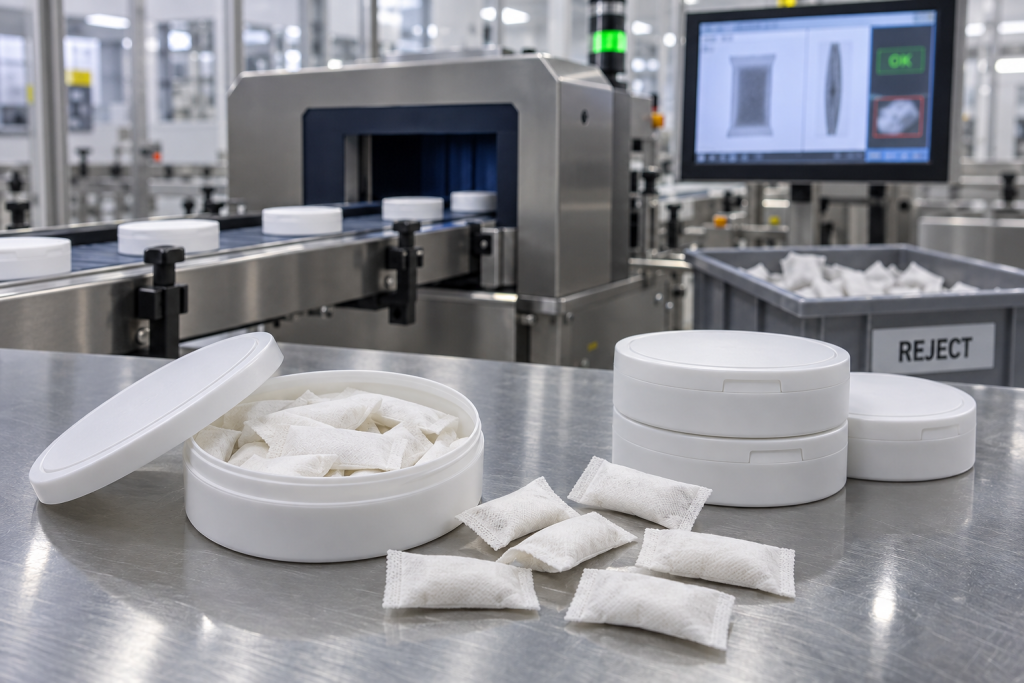
Potential foreign material can originate from incoming powders, damaged utensils, screens, fasteners, cutting components, packaging material or maintenance activity. The team should map where contamination could enter, which preventive controls already exist and where detection is technically effective. A detector at the end of the line cannot compensate for uncontrolled maintenance or damaged equipment. Ask how the OEM inspects high-risk components, accounts for tools and blades, controls glass and brittle plastic, and releases equipment after repair.
Match inspection technology to the pack
Metal detectors respond to conductive and magnetic contaminants, but sensitivity changes with product effect, aperture, line speed, orientation and package material. X-ray systems may detect some dense materials and verify pack attributes, but they do not detect every plastic, fiber or low-density contaminant. A realistic validation uses the actual filled pouch or closed can at normal operating conditions. Record the smallest reliably detectable challenge sizes by material and position, without presenting them as universal guarantees for every SKU.
Challenge checks and reject control
Define challenge standards, placement, check frequency and actions after a failed check. Operators should verify that the system detects the challenge and that the reject device removes and securely contains the affected unit. The process also needs reject reconciliation, investigation of repeated rejects, status control for product made since the last acceptable check, and documented restart approval. Test records should identify the line, product, batch, time, operator, challenge pieces and result.
What buyers should request
Request the foreign-material risk assessment, preventive-maintenance program, detector or X-ray specification, current validation summary, routine challenge SOP, recent check records, reject and deviation workflow, calibration or service status and complaint trend. During an audit, follow one rejected unit from detection to secured disposition. Confirm that the control applies to the actual pouch and can configuration and that a packaging or formula change triggers an assessment rather than automatic carryover.
Key parameters buyers should record
- Target market, sales channel and responsible business
- Formula, amount per pouch, pouch count and commercial packaging configuration
- Test method, conditions, sample status and predefined acceptance criteria
- Named owner for approval, deviations, changes and release
Frequently asked questions
Does every nootropic pouch line need an X-ray system?
No. Technology selection should follow the documented hazard analysis and the actual product and packaging limitations.
Can a metal detector find glass or hard plastic?
Generally not reliably. Other prevention, visual, supplier and detection controls may be needed for nonmetal hazards.
What happens after a failed challenge check?
The OEM should contain potentially affected product, investigate, correct the cause, repeat acceptable checks and document release decisions.
Source and related reading
Technical boundary references include the FDA dietary supplement CGMP guide. Continue with the quality-control buyer guide, packaging guide and OEM project inquiry.
Reviewed 29 September 2026. General B2B educational information; confirm product, market, laboratory, customs and contractual requirements for the actual project.