
Why barrier performance matters
Nootropic pouch formulas can contain hygroscopic carriers, botanical extracts, flavors and active ingredients that respond differently to moisture and oxygen. Excess humidity can change texture, pouch feel, powder flow and flavor release; oxygen exposure can accelerate aroma loss or oxidation in sensitive components. The risk depends on the complete formula and target shelf life. Buyers should identify critical quality attributes first, then ask the packaging supplier and OEM to show how the selected closure system protects them. A generic statement such as “airtight can” is not a measurable specification and should not replace a documented barrier and stability plan.
OTR and WVTR are condition-dependent
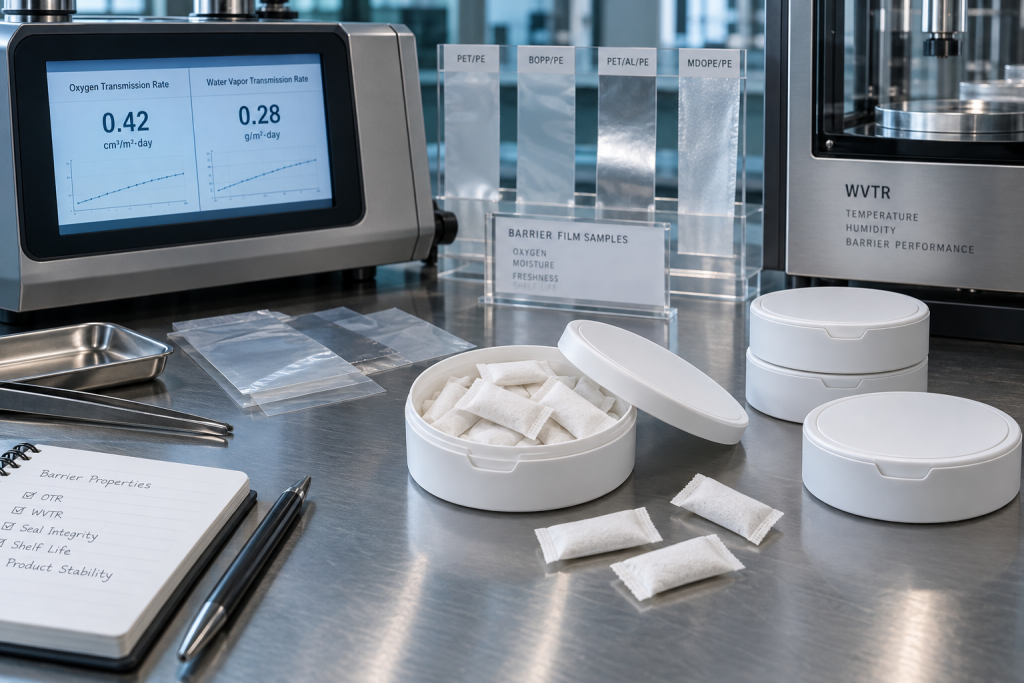
Oxygen transmission rate and water-vapor transmission rate describe permeation under specified test conditions. Results cannot be compared responsibly when temperature, relative humidity, exposed area, sample thickness or method differs. ASTM lists methods for oxygen transmission through films and dry packages, while ASTM F1249 addresses water-vapor transmission through flexible barrier materials. Ask for the method, conditions, units and specimen description with every value. Do not copy a film supplier’s flat-sheet result directly into a finished-can claim because closures, seams and headspace create additional pathways.
Test the whole commercial pack
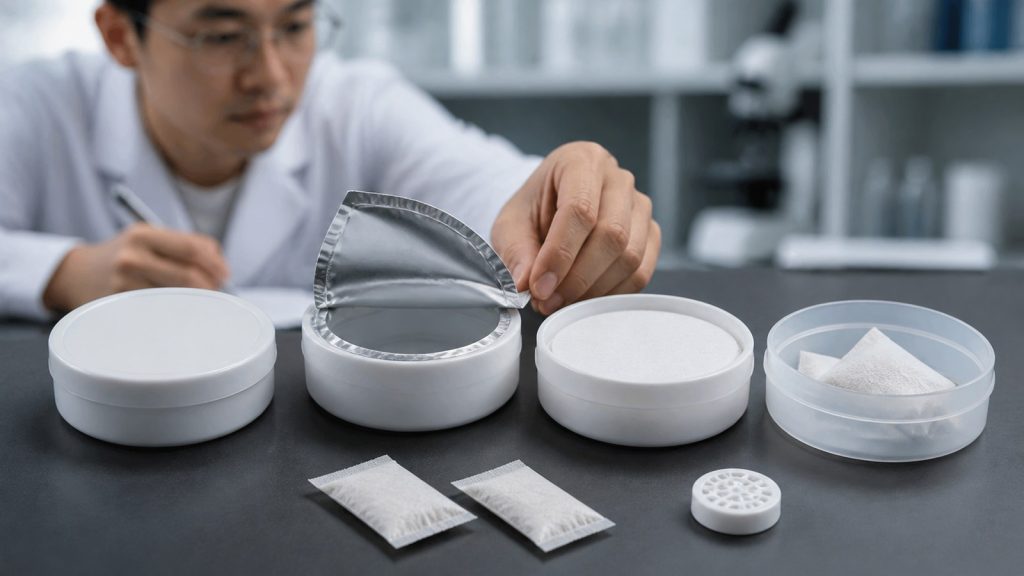
Use production-equivalent pouches, pouch count, filled weight, can resin, lid, hinge, label and any liner or tamper feature. Compare candidate packs during real-time and, where justified, accelerated stability. Record mass change, water activity or moisture, active assay where relevant, odor, taste, pouch texture, clumping, discoloration and closure function. Include transport and repeated-opening scenarios if the consumer will open the can many times. The objective is not the lowest numerical transmission rate; it is a package that maintains agreed product attributes for the labeled storage period.
Buyer specification checklist
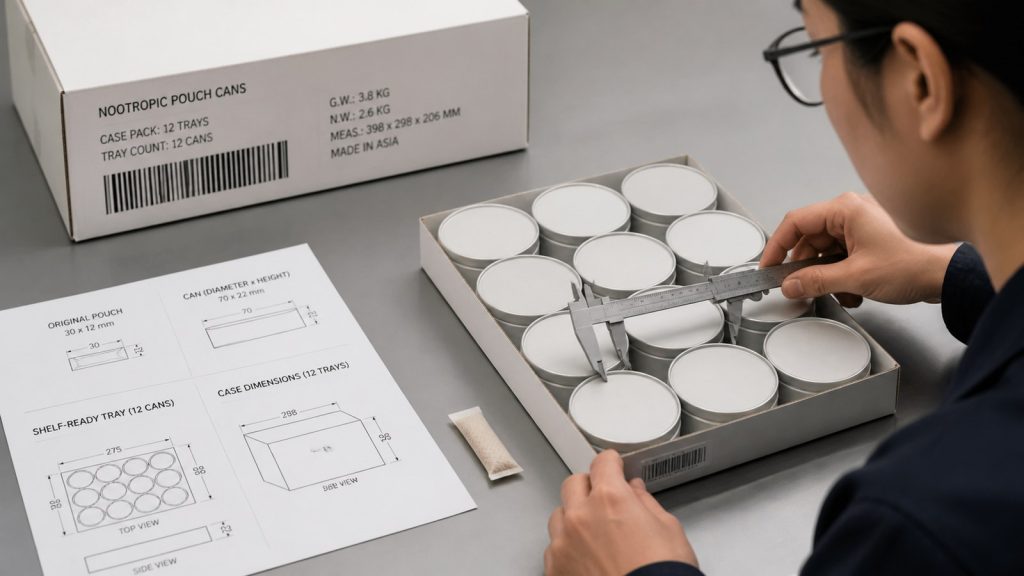
Define the target shelf life and storage statement; identify moisture- and oxygen-sensitive ingredients; record the exact can and closure drawing; specify test method and environmental conditions; agree on acceptance criteria; evaluate sealed finished packs; retain samples from commercial batches; and trigger requalification after material, supplier, wall-thickness, closure or formula changes. If a desiccant or oxygen absorber is proposed, confirm compatibility, ingestion warnings, placement, capacity and how its presence affects the pouch count and user experience.
Key parameters buyers should record
- Target market, sales channel and responsible business
- Formula, amount per pouch, pouch count and commercial packaging configuration
- Test method, conditions, sample status and predefined acceptance criteria
- Named owner for approval, deviations, changes and release
Frequently asked questions
Is the lowest WVTR always best?
No. Barrier level, cost, recyclability, closure performance and the product’s actual sensitivity must be evaluated together.
Can OTR or WVTR prove shelf life?
Not alone. Transmission data supports package selection, while finished-product stability under the commercial pack supports shelf life.
Should the can or only its material be tested?
Both can be useful, but release decisions should include the complete closed package because joints and closures can dominate performance.
Source and related reading
Technical boundary references include ASTM packaging standards and ASTM F1249. Continue with the quality-control buyer guide, packaging guide and OEM project inquiry.
Reviewed 29 September 2026. General B2B educational information; confirm product, market, laboratory, customs and contractual requirements for the actual project.