

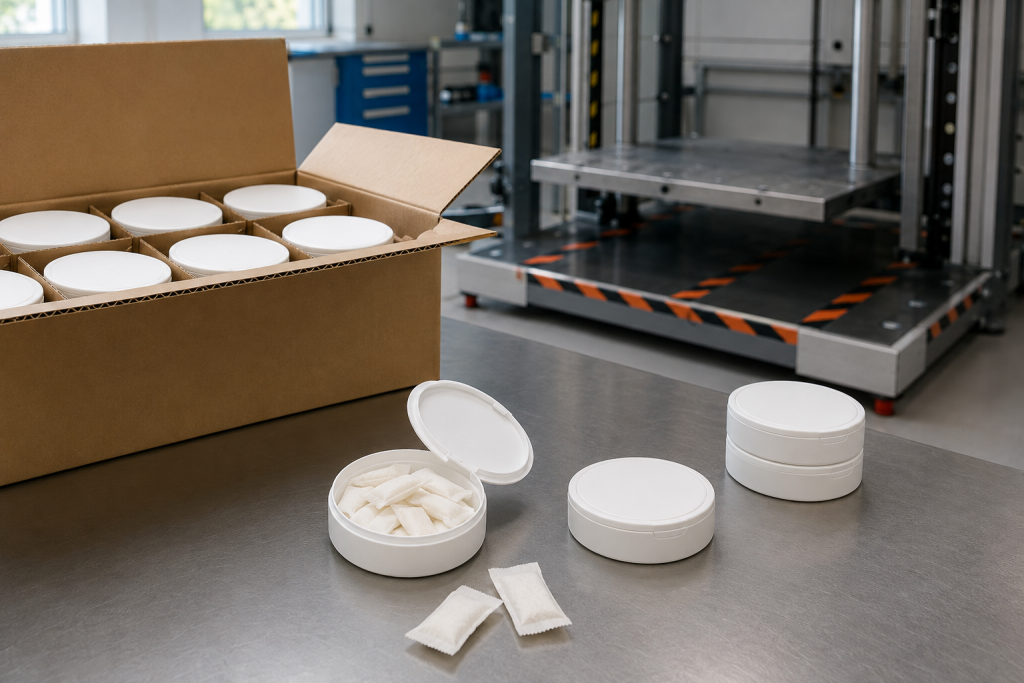
Quick answer: A nootropic pouch shipping carton drop test uses production-equivalent filled cans, inner packs and master cartons to check whether the complete shipping configuration can tolerate defined free-fall impacts. Buyers should agree on the test method, distribution route and pass criteria before testing. A drop result is valuable, but it does not replace vibration, compression, temperature, humidity or packaging compatibility studies.
Why transit testing matters for oral pouch products
Nootropic pouches are compact, but their shipping system has several vulnerable interfaces: the pouch seam, the can lid and hinge, the body label, the display carton, dividers and the corrugated master case. A parcel impact can open a lid, crack a can, scuff critical label copy, collapse an inner carton or transfer load into the filled pouches.
These failures can be missed when an OEM buyer evaluates only one attractive sales sample. Transit validation should represent the commercial pack that will actually leave the factory, including the real pouch count, filled weight, label, tamper feature, divider, tape and carton board.
Define every packaging level before the test
| Packaging level | Buyer questions |
|---|---|
| Individual can | Does the lid remain closed? Are the hinge, opening tab, label and optional tamper feature intact? |
| Inner or display carton | Does it restrain the cans without excessive movement, abrasion or crushing? |
| Master shipping carton | Are board grade, dimensions, dividers, void fill, closure tape and gross weight production-equivalent? |
| Pallet or parcel configuration | Will the order travel as an individual courier parcel, mixed ecommerce shipment or unitized pallet load? |
Choose a method that matches the distribution route
ASTM D5276 describes free-fall drop testing of loaded containers and can help assess a container’s ability to protect its contents from sudden shock. The correct program may also draw on an appropriate ISTA packaged-product test procedure. The buyer, manufacturer and test laboratory should select the procedure for the pack weight, handling system and shipment mode rather than borrowing a competitor’s drop height.
The agreed protocol should identify the specimen count, conditioning, drop equipment, drop height, orientation sequence and inspection points. Faces, edges and corners should be identified consistently under the chosen method. Record the carton construction, packed gross weight and photographs so a later repeat test uses the same configuration.
Use production-equivalent test samples
- Fill each can with the intended number and weight of finished pouches.
- Use the commercial can resin, lid, label and tamper feature.
- Pack cans in the actual orientation, inner carton and divider layout.
- Use the specified corrugated board, closure tape and application pattern.
- Condition samples when heat, cold or humidity may change carton or plastic performance.
- Mark specimens and photograph their condition before the first impact.
Empty cans are poor substitutes because they change the mass, center of gravity and forces transferred through the pack. Prototype materials may be suitable for an early screening test, but a commercial release decision should use production-representative components.
Practical acceptance criteria for OEM buyers
Write pass or fail rules before testing. Otherwise, a supplier and buyer may interpret the same dented carton differently. Typical checks include:
- No cracked can body, broken hinge or separated lid
- No unintended opening and no loss of pouches
- No torn pouch seam, visible leakage or loose powder in the can
- Correct pouch count after the test
- Required warnings, lot code and barcode remain present and legible
- Inner packs continue to restrain the cans
- Master carton remains safe to handle and protects the contents
Cosmetic scuffing can have a different limit from a functional failure. Define both. When an impact is severe, consider follow-up moisture, flavor and stability evaluation; an intact-looking can does not by itself prove that its barrier system or shelf life is unchanged.
Why a drop test alone is not enough
Real distribution creates repeated vibration, stacking load, temperature and humidity cycles, pressure changes and abrasion. A carton may pass one impact yet allow cans to rub during a long truck journey. Another pack may survive parcel handling but creep or collapse at the bottom of a pallet.
Build a risk-based validation plan that can include vibration, compression or stacking, hot and cold conditioning, humidity, pressure or altitude exposure and packaging-product compatibility. The combination should reflect the target route. “FBA ready” or “parcel safe” should not be treated as a universal material specification.
Improve the pack after a failure
Use the failure location to guide corrective action. Lid opening may indicate excessive can movement or direct load transfer. Crushed corners may require a revised case fit, board specification or divider. Label abrasion may improve with orientation or restraint changes. Tape failure may need a different tape grade, width or application pattern.
Avoid adding material without diagnosis. Oversized cartons and unnecessary void fill can increase movement, freight volume and waste. After any structural change, repeat the relevant test with a controlled revision number and retain the report, images and approved pack specification.
Frequently asked questions
Does every production batch need a carton drop test?
Not necessarily. Many buyers validate a packaging design and repeat testing after meaningful changes, failures or supplier changes. Routine batch inspections should still confirm that approved materials, dimensions, pack-out and closure are used.
Can empty nootropic pouch cans be used?
They are not representative for release testing. Use the intended pouch count and product weight because mass and load transfer affect impact performance.
Does a passed drop test prove shelf life?
No. It evaluates specified mechanical impacts. Shelf life requires appropriate product stability and packaging barrier or compatibility evidence.
Which drop-test standard should a buyer specify?
It depends on the packaged-product weight, destination, parcel or pallet route and customer requirements. Agree on the relevant ASTM, ISTA or customer protocol with a qualified laboratory before samples are prepared.
Related packaging resources
Continue with our nootropic pouch packaging guide, retail case-pack specification guide, bulk shipping and storage guide or request an OEM packaging review.
Reviewed 8 September 2026. General B2B educational information; buyers should confirm market, carrier and customer-specific requirements.