

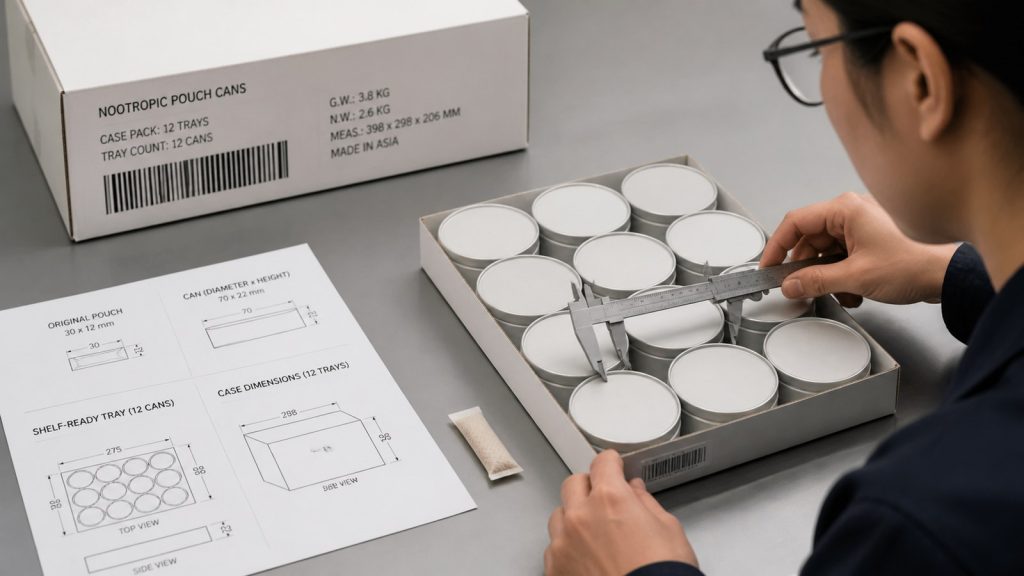
Quick answer: A retail case-pack specification defines how sellable cans move from factory to shelf. Buyers need cans per tray, trays per master carton, internal and external dimensions, gross and net weight, barcode hierarchy, lot/date visibility, pallet pattern and compression limits before quoting freight or presenting to retailers.
What buyers need to understand
Start with shelf depth, replenishment method and retailer receiving rules. A shelf-ready tray should protect cans, open cleanly and preserve front-facing presentation. Avoid a carton that saves material but collapses during stacking.
How to specify and verify it
Create an item-and-case master-data sheet. Verify measurements on packed samples, not CAD alone. Test scan quality, handling, drop and compression performance and confirm every packaging level uses the correct GTIN and lot information.
Buyer documentation checklist
| Area | Evidence |
|---|---|
| Specification | Controlled product, pouch, packaging and acceptance requirements |
| Process | Equipment settings, sampling, cleaning and line-clearance records |
| Quality | Lot traceability, deviations, CAPA, release and retained samples |
| Commercial | MOQ, lead time, responsibilities, replacements and change notification |
Common mistakes
- Approving a visual sample without measurable criteria
- Using averages that hide unit-to-unit or lot-to-lot variation
- Printing packaging before specifications and claims are final
- Accepting supplier changes without documented risk review
Frequently asked questions
Should approval be documented by SKU?
Yes. Formula, flavor, strength, count and packaging versions should be traceable to a controlled approval.
Can a supplier certificate replace buyer verification?
No. Certificates support due diligence but must match the material, lot, method and intended finished product.
When should testing be repeated?
Repeat it after relevant supplier, formula, process, packaging or destination-market changes and according to the ongoing control plan.
Related resources
See the 2026 buyer’s guide, quality-control guide and OEM project inquiry.
Reviewed 23 August 2026. General B2B educational information only.
Buyer decision summary
Use this page as a decision framework, not as a substitute for a signed product specification or market-specific review. A credible nootropic pouch project identifies the finished product category, the amount of every active per pouch, total caffeine from all sources, intended adult use, packaging configuration and target jurisdiction. Commercial figures such as MOQ and lead time should be tied to the actual formula, flavor, strength and artwork version. Before approval, compare a production-equivalent sample with measurable acceptance criteria and assign responsibility for claims, labels, release testing and later changes. This prevents a general marketing statement from being mistaken for a guaranteed specification and gives procurement, formulation, quality and regulatory teams the same reference point.
Key parameters to confirm
- Product identity: State whether the SKU contains nicotine, tobacco or caffeine; these are not interchangeable categories.
- Dose basis: Show every active amount per pouch and per serving, including caffeine from all sources.
- Evidence boundary: Describe intended support without promising treatment, disease prevention or guaranteed results.
- User boundary: Define adult-use guidance, warnings, maximum daily use and conditions requiring professional advice.
Continue this topic
- What Are Nootropic Pouches? A Practical Guide for First-Time Users
- How Do Nootropic Pouches Work? Release, Absorption and Onset Explained
- Are Nootropic Pouches Safe? A Caffeine, Ingredient and Oral-Comfort Checklist
Content status: Reviewed 13 September 2026. General B2B information; project-specific commercial, technical and regulatory details require written confirmation.