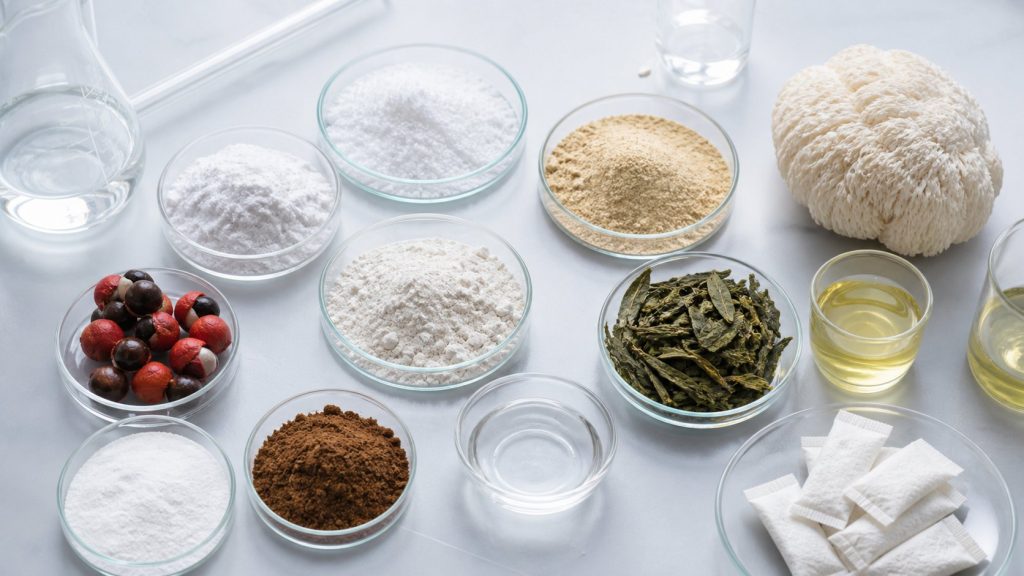


Quick answer: A nootropic formula must be manufacturable as well as attractive on paper. Particle-size distribution, density, shape, electrostatics, moisture and cohesion control how reliably the blend flows into each pouch. Poor flow can cause weight variation, active segregation, dust, weak seams and slow production.
Why this variable matters
Very fine powders may disperse poorly, cling to equipment or contaminate seals. Large density and particle-size differences encourage segregation during transfer and vibration. Granulation, milling, sieving or compatible carriers may improve performance, but each change can affect release, taste and stability.
How buyers should verify it
Request particle-size distribution, bulk and tapped density, moisture, flow observations and pilot-line results for the actual blend. Confirm that processing does not damage sensitive extracts or create an unjustified change in ingredient identity or label declaration.
Recommended OEM data package
| Area | Evidence to request |
|---|---|
| Raw materials | Identity, grade, particle or physical specification and lot records |
| Blend | Mixing order, time, hold period and segregation controls |
| Process | Equipment, setup, line speed, in-process checks and deviations |
| Finished product | Fill weight, active assay, uniformity, moisture, seams and release approval |
Common buyer mistakes
- Using average pouch weight as proof of dose uniformity
- Approving a laboratory blend without a commercial-line trial
- Changing an ingredient supplier without repeating flow and sensory checks
- Ignoring dust accumulation and powder trapped in heat seals
Frequently asked questions
Does equal pouch weight guarantee equal active dose?
No. The active must also remain uniformly distributed in the blend and be measured with a suitable method.
Can a carrier improve pouch filling?
It may improve density, flow or distribution, but compatibility, dose space, label status, taste and stability must be reviewed.
Should commercial batches be checked during the run?
Yes. A risk-based plan should sample appropriate stages and positions so drift or segregation is not hidden by a batch average.
Related resources
See our manufacturing overview, quality-control guide and OEM project inquiry.
Reviewed 22 August 2026. General B2B educational information only.
Buyer decision summary
Use this page as a decision framework, not as a substitute for a signed product specification or market-specific review. A credible nootropic pouch project identifies the finished product category, the amount of every active per pouch, total caffeine from all sources, intended adult use, packaging configuration and target jurisdiction. Commercial figures such as MOQ and lead time should be tied to the actual formula, flavor, strength and artwork version. Before approval, compare a production-equivalent sample with measurable acceptance criteria and assign responsibility for claims, labels, release testing and later changes. This prevents a general marketing statement from being mistaken for a guaranteed specification and gives procurement, formulation, quality and regulatory teams the same reference point.
Key parameters to confirm
- Product identity: State whether the SKU contains nicotine, tobacco or caffeine; these are not interchangeable categories.
- Dose basis: Show every active amount per pouch and per serving, including caffeine from all sources.
- Evidence boundary: Describe intended support without promising treatment, disease prevention or guaranteed results.
- User boundary: Define adult-use guidance, warnings, maximum daily use and conditions requiring professional advice.
Continue this topic
- What Are Nootropic Pouches? A Practical Guide for First-Time Users
- How Do Nootropic Pouches Work? Release, Absorption and Onset Explained
- Are Nootropic Pouches Safe? A Caffeine, Ingredient and Oral-Comfort Checklist
Content status: Reviewed 13 September 2026. General B2B information; project-specific commercial, technical and regulatory details require written confirmation.