

A mushroom extract described as 10:1 does not, by itself, disclose beta-glucan content or clinical potency. The ratio describes a stated material relationship. A sourcing comparison needs the species, material used, extraction basis and measured composition.
Editorial scope: technical development and supplier review. Published 16 November 2026. The study and control suggestions below are not reported results from this supplier.
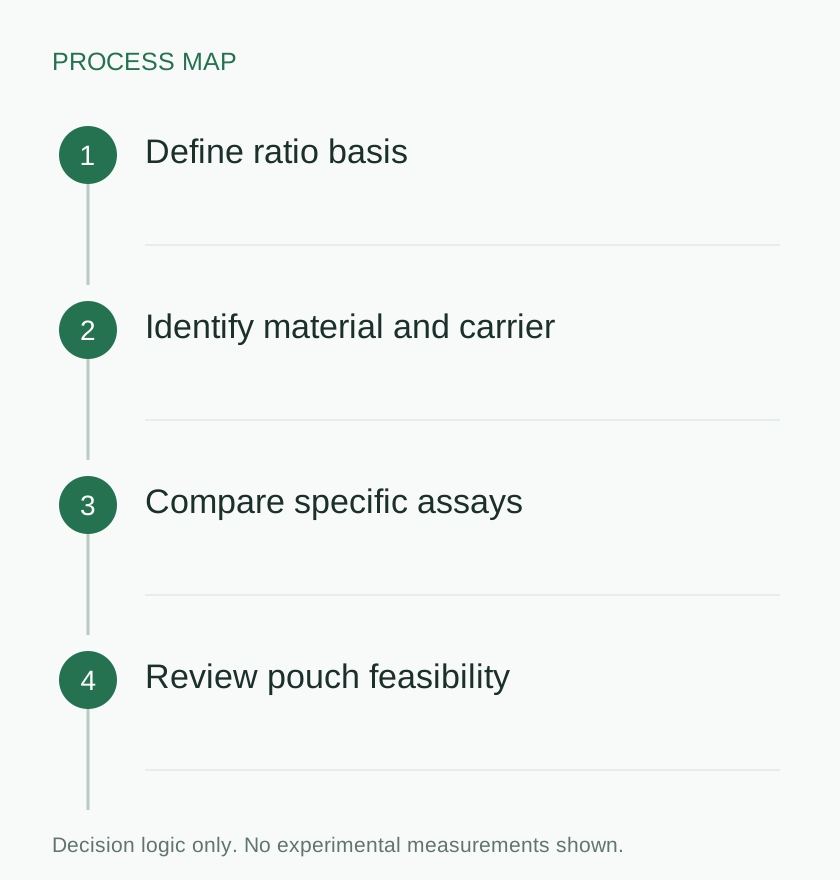
Request the definition behind the ratio
Ask whether the ratio is input dry mushroom to native extract, or to a final powder that includes a carrier. Record fruiting body, mycelium and growth-substrate information as applicable. Two suppliers can use the same ratio with different definitions. The ratio cannot substitute for a species identity strategy or a mass balance.
Compare assays with the same meaning
Distinguish total polysaccharides, total glucans, alpha-glucans and beta-glucans. Methods and reporting bases matter. A starch-rich carrier can affect some broad carbohydrate measurements without establishing the target mushroom composition. Published extraction studies show that measured composition depends on the material and process; their results are not specifications for an unrelated pouch ingredient.
Translate the material into a feasible formula
Calculate the amount of supplied powder and the measured marker contribution per pouch on the declared basis. Then assess taste, physical loading and assay suitability in the finished matrix. A marker value can support quality control, but it does not prove a cognitive benefit, human absorption or equivalence to the material used in a clinical study.
Development review checklist
- Define species and supplied mushroom material.
- Request native-extract and carrier quantities.
- Record the exact ratio calculation.
- Use comparable marker methods and reporting bases.
- Assess finished-pouch content and claims separately.
Buyer questions
Does 10:1 mean ten times as effective?
No. A material ratio is not a biological potency result.
Is total polysaccharide content equal to beta-glucan?
No. The reported analytical categories and methods differ.
Can a fruiting-body name replace species identification?
No. Species and the material part are separate fields.
Should a carrier be excluded from the formula calculation?
No. It contributes to the actual supplied mass and finished formulation.
Can extract ratios establish clinical equivalence?
No. Compare composition, preparation, exposure and study context rather than the ratio alone.
References and scope
- Comparison of the Conventional, Chemical, and Ultrasound Extraction of Crude Polysaccharides and Their Properties from Lentinula edodes
Primary extraction/composition study; no therapeutic effects are claimed for a pouch.
- FDA: Small Entity Compliance Guide, Dietary Supplement CGMP
Specifications and production records where dietary-supplement classification applies; not automatic classification of every oral pouch.
- FDA: ICH Q2(R2), Validation of Analytical Procedures
Fit-for-purpose analytical validation framework; pharmaceutical guidance used as technical background, not a certification for these products.
Discuss the specification and evidence needed for your project. Send the intended use, destination market and the attribute you need to verify. Commercial capability and acceptance criteria require a project-specific agreement.