

The name L-theanine should identify a defined ingredient, not just a total nitrogen result or an unnamed tea extract. Sourcing documents need to distinguish chemical identity, stereochemical form, amount and any claim about the production source.
Editorial scope: technical development and supplier review. Published 16 November 2026. The study and control suggestions below are not reported results from this supplier.
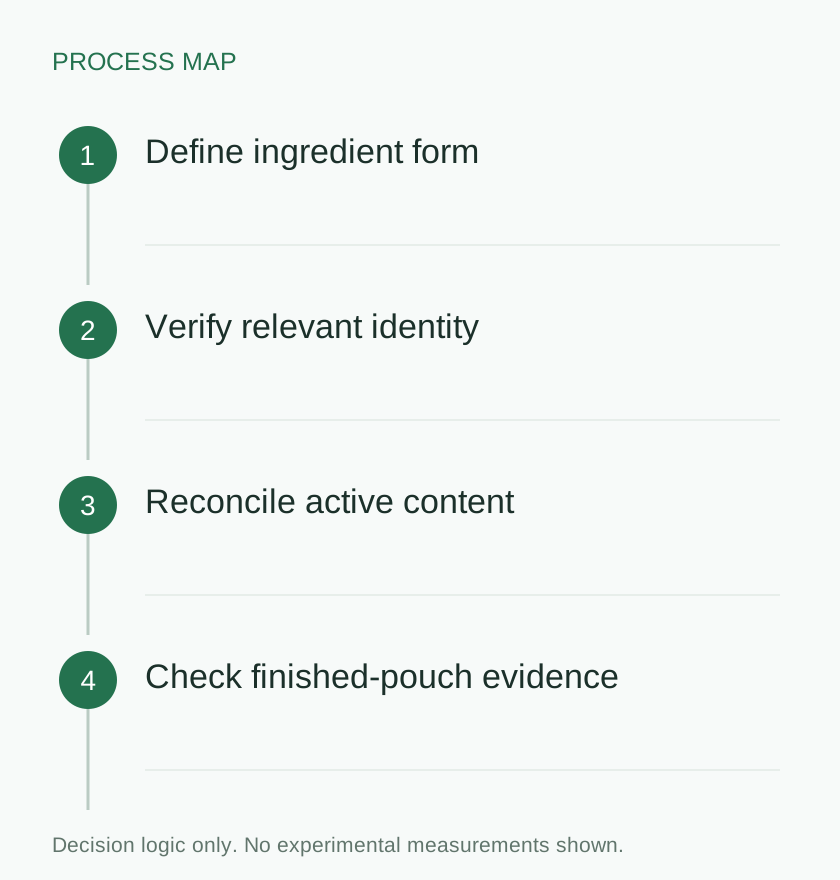
Separate identity from origin claims
Specify the chemical form and the supplied material's composition. A tea-derived extract and an isolated ingredient can contain different accompanying compounds. A supplier's natural-origin statement is a separate claim from identity and needs traceable support. The production route alone does not establish the finished pouch's efficacy or suitability.
Ask whether the method resolves the specification
A general assay may report theanine without distinguishing stereochemical forms. If the specification requires L-theanine, determine which identity and, where needed, enantioselective evidence supports it. Published isotope-ratio work explores origin discrimination in particular sample sets; it should not be treated as a universal one-test certificate for every supply route.
Carry the definition into the finished pouch
Record whether the formula uses neat ingredient, a diluted blend or an extract. Reconcile the amount of L-theanine with carrier and moisture contributions. Finished-product method suitability still matters because flavors and other ingredients can affect extraction and detection. Do not transfer a study result from a differently composed capsule or beverage directly to a pouch claim.
Development review checklist
- State the exact supplied form and concentration basis.
- Separate stereochemical identity from sourcing claims.
- Review the selectivity of the stated assay.
- Document carriers and any co-extracted caffeine.
- Qualify the finished-pouch analytical preparation.
Buyer questions
Does theanine on a COA necessarily mean L-theanine was resolved?
No. Check what the reported method can distinguish.
Does a tea extract label establish a fixed L-theanine amount?
No. A quantified specification and suitable assay are needed.
Are natural-origin and chemically identical the same claim?
No. They answer different questions and need different evidence.
Can a supplier's ingredient study prove a pouch benefit?
Only a justified evidence assessment can establish relevance to the finished formula, exposure and claimed outcome.
What should a buyer do with an unspecified carrier?
Clarify its identity and amount before approving the material and label.
References and scope
- Characterization of L-theanine in tea extracts and synthetic products using stable isotope ratio analysis
Primary sourcing-characterization study; not proof of efficacy or universal origin discrimination.
- FDA: ICH Q2(R2), Validation of Analytical Procedures
Fit-for-purpose analytical validation framework; pharmaceutical guidance used as technical background, not a certification for these products.
- FDA: Small Entity Compliance Guide, Dietary Supplement CGMP
Specifications and production records where dietary-supplement classification applies; not automatic classification of every oral pouch.
Discuss the specification and evidence needed for your project. Send the intended use, destination market and the attribute you need to verify. Commercial capability and acceptance criteria require a project-specific agreement.