

A low-level ingredient can be correctly weighed into a mixer and still be unevenly distributed in finished pouches. Premix design should address the smallest measured ingredient, its physical properties and what happens during transfer to the filler.
Editorial scope: technical development and supplier review. Published 16 November 2026. The study and control suggestions below are not reported results from this supplier.
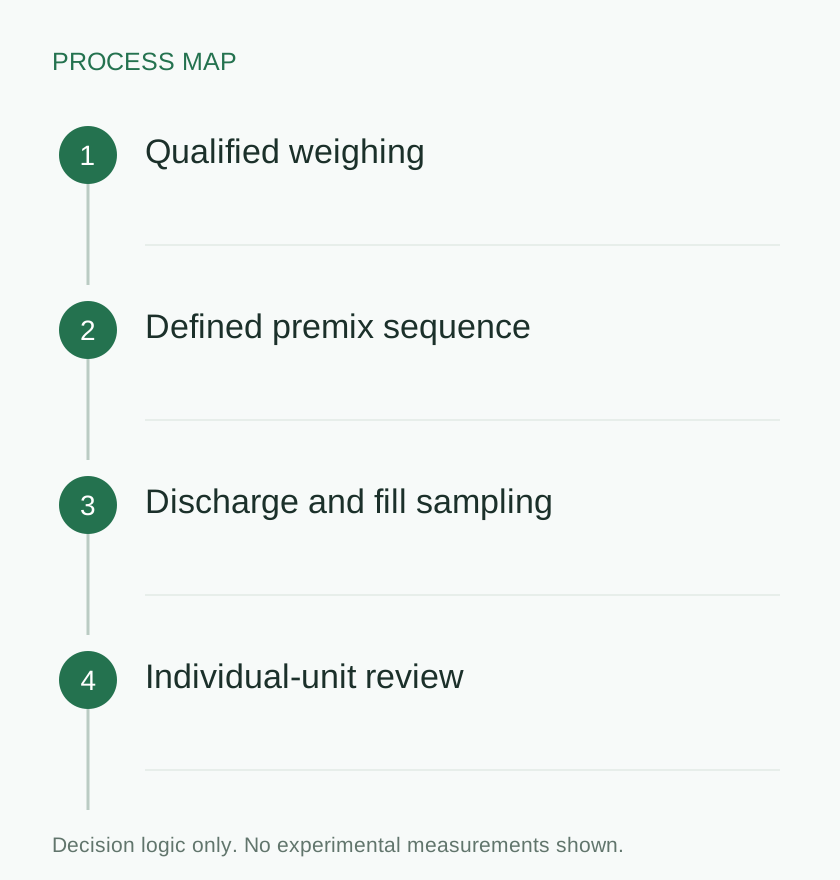
Build the premix around measurable quantities
Identify the minimum weighable quantity with the proposed balance and batch size. Record ingredient assay, carrier composition and any potency conversion. Use a justified dilution sequence rather than adding a tiny quantity directly to a large mass. The documented sequence should specify each addition and mixing step, including what is checked before the premix enters the main blend.
Sample the process after the mixer
A blend result collected at one convenient location does not characterize all output. Choose sampling locations and times that address segregation during discharge, transfer and hopper depletion. Particle size, density and cohesion can differ between ingredients. A convenient marker may help investigate the process, but it cannot automatically establish uniformity for every component.
Compare variation with the method capability
A wide finished-unit distribution can reflect the blend, filling or analytical preparation. Evaluate those sources separately. Set content criteria and the sampling plan before the study, then review individual results instead of averaging a failure away. For a proposed supplement, applicable specifications and production controls need to be assessed under the relevant market framework.
Development review checklist
- Verify minimum weighable quantity for the batch.
- Document the complete dilution and mixing sequence.
- Sample discharge and filling stages.
- Choose analytically measurable markers with a justified relationship.
- Investigate unit variation before approving scale-up.
Buyer questions
Does mixing longer always improve uniformity?
No. Establish a process window; additional handling can also allow segregation or change the material.
Can a colorant prove every ingredient is uniform?
Not without a demonstrated relationship. A visible tracer may behave differently from the active ingredients.
Why sample the last units filled?
Hopper depletion and transfer can change the composition reaching the filler.
Can composite samples hide a low-level ingredient problem?
Yes. A composite average can conceal unit-to-unit variation.
What should an OEM transfer package include?
The premix sequence, weighing capability, sampling map, analytical methods and the acceptance criteria for finished units.
References and scope
- FDA: Small Entity Compliance Guide, Dietary Supplement CGMP
Specifications and production records where dietary-supplement classification applies; not automatic classification of every oral pouch.
- FDA: ICH Q2(R2), Validation of Analytical Procedures
Fit-for-purpose analytical validation framework; pharmaceutical guidance used as technical background, not a certification for these products.
Discuss the specification and evidence needed for your project. Send the intended use, destination market and the attribute you need to verify. Commercial capability and acceptance criteria require a project-specific agreement.