

A focus blend may contain caffeine from several ingredients even when the front label highlights only one. Build the calculation from each raw material's composition, then confirm the total in finished pouches. This avoids both omission and double counting.
Editorial scope: technical development and supplier review. Published 16 November 2026. The study and control suggestions below are not reported results from this supplier.
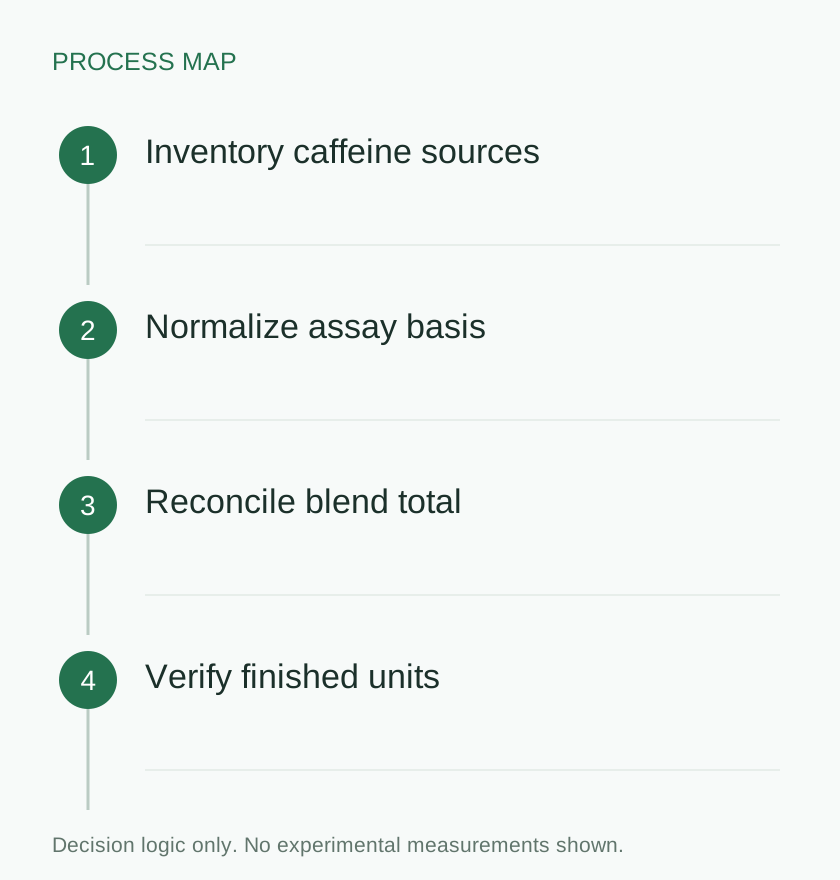
Make a source-by-source inventory
List separately added caffeine, guarana, tea, coffee, mate and any premix that may contribute caffeine. Ask for the relevant lot assay and reporting basis. A caffeine-free trade name is not a substitute for a specification. Likewise, an extract name does not reveal a constant caffeine percentage across suppliers or grades.
Reconcile the arithmetic with the analytical total
As a calculation example, 50 mg of a hypothetical extract assayed at 20% caffeine contributes 10 mg. If 20 mg caffeine is separately added, the calculated total is 30 mg before considering other sources and manufacturing variation. If a premix report already states total caffeine, do not add its subcomponents again. Verify the finished unit with a suitable method.
Review the consumer-facing meaning
Caffeine-free and stimulant-free are different statements. Other ingredients may have relevant physiological effects or market restrictions. FDA caffeine guidance also emphasizes considering all sources; its general adult figure is not approval of a product or a claim. Have the intended wording, warnings and serving definition reviewed for the destination market and target population.
Development review checklist
- List every possible caffeine-contributing ingredient.
- Use lot-specific composition and a clear assay basis.
- Track totals through premixes to prevent double counting.
- Confirm finished-unit caffeine analytically.
- Review free-from wording and exposure independently.
Buyer questions
Can a blend contain caffeine without added caffeine powder?
Yes, botanical ingredients can contribute caffeine.
Does decaffeinated necessarily mean zero caffeine?
No. Request the specification and an appropriate analytical result.
Should a premix total be added to its individual caffeine sources?
No. That would count the same material twice.
Can a nicotine-free pouch be assumed caffeine-free?
No. These are independent composition statements.
Is a calculated formula total enough for a label?
It supports formulation accounting, but the applicable labeling basis and finished-product evidence must also be addressed.
What should happen when an extract supplier changes grade?
Recalculate source contributions and assess testing, labeling and change-control consequences before use.
References and scope
- FDA: Spilling the Beans, How Much Caffeine Is Too Much?
Total caffeine from all sources; 400 mg/day statement limited to most adults, not a target or universal safe limit.
- EFSA: Caffeine
Population and exposure qualifications for caffeine risk assessment, not approval of a pouch or claim.
- FDA: ICH Q2(R2), Validation of Analytical Procedures
Fit-for-purpose analytical validation framework; pharmaceutical guidance used as technical background, not a certification for these products.
Discuss the specification and evidence needed for your project. Send the intended use, destination market and the attribute you need to verify. Commercial capability and acceptance criteria require a project-specific agreement.